
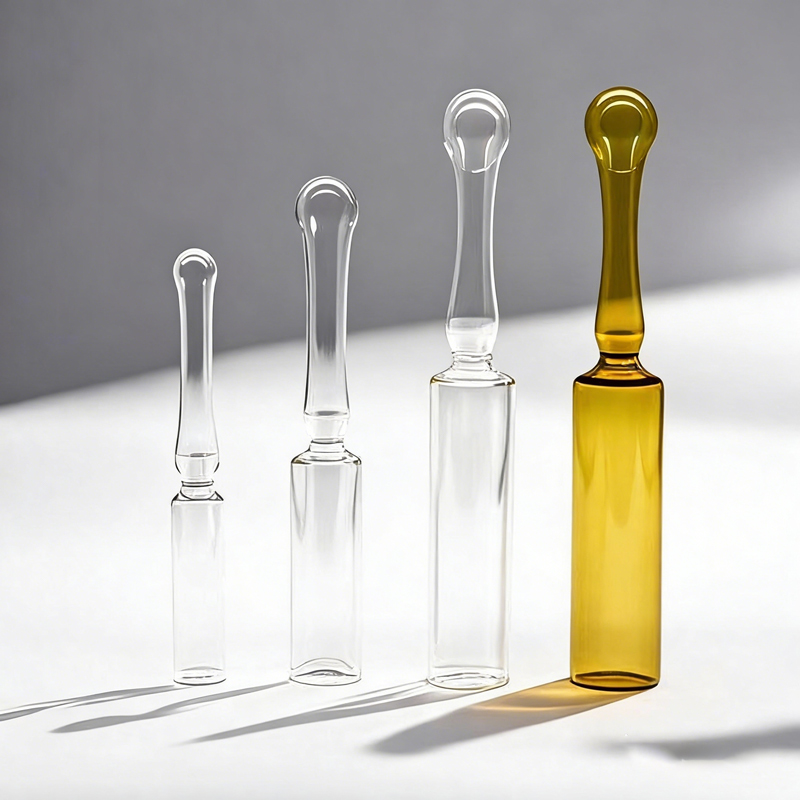
Introduction
For procurement and quality teams at pharmaceutical companies, choosing a glass ampoule supplier is never a decision that can be treated casually. Ampoules come into direct contact with injectable drug products, run at high speed on filling lines, and are ultimately opened by hand at the clinical bedside. Any deviation at any stage—dimensional tolerance, breaking force fluctuation, or surface defects—can translate into batch rejection, line downtime, or even patient safety incidents.
This article examines the criteria that truly matter when selecting an ampoule supplier, from the perspective of the pharmaceutical companies who use them.
Dimensional Consistency: The Hidden Driver of Line Efficiency
Many procurement teams focus on unit price and lead time while underestimating the importance of dimensional consistency.
For pharmaceutical companies operating automated filling lines, batch-to-batch variation in critical dimensions—total height, body outer diameter, neck outer diameter, wall thickness—directly affects filling, sealing, and inspection operations. If geometric dimensions differ noticeably between batches, the line may require parameter readjustment at every batch change, or may experience jamming and breakage.
A more insidious risk is that sample qualification does not guarantee production qualification. A supplier may submit samples that meet every dimension on the specification sheet, yet fail to sustain that precision across commercial production. When evaluating suppliers, pharmaceutical companies should therefore examine whether the supplier has appropriate in-process inspection procedures and measurement equipment to monitor critical dimensions during production.
For long-term pharmaceutical packaging programs, batch-to-batch consistency is often worth more than a lower purchase price.
Breaking Force Control: Protecting Both Clinical Safety and Brand Reputation
The breaking force of a glass ampoule is an underappreciated critical quality parameter. Too high, and healthcare workers struggle to open it, potentially injuring themselves in the process. Too low or too variable, and the ampoule may break prematurely during transport or generate glass particles that contaminate the drug solution.
Industry survey data reveals a concerning reality: 89% of healthcare workers have encountered ampoules that were difficult to open, and this issue costs the healthcare industry over €1 billion annually, with each nurse discarding an average of 114 ampoules per year.
Pharmacopoeial standards specify breaking force ranges for different ampoule sizes. The Chinese Pharmacopoeia General Chapter 4018, for example, sets the breaking force range for 1 ml ampoules at 25–80 N and for 10 ml ampoules at 30–90 N.
For pharmaceutical companies, this means a supplier’s breaking force control capability directly affects:
- End-user experience: whether healthcare workers can open ampoules safely and smoothly
- Particle contamination risk: unstable breaking force can generate glass fragments
- Brand quality perception: poor user experience affects how customers perceive drug quality
A professional supplier should be able to provide consistent breaking force data, not merely meet the minimum regulatory requirement.
Documentation and Regulatory Support: From “Having Certificates” to “Being Auditable”
In the regulated world of pharmaceutical packaging, “what certifications do you have” is an oversimplified question. A more valuable question is: how do you control quality, and how do you prove it in writing?
What pharmaceutical companies need from suppliers goes far beyond an ISO certificate. Key documents include:
- Batch-specific test reports covering critical dimensions and hydrolytic performance
- Glass type documentation confirming Type I borosilicate and providing material data
- Sterilization validation data where applicable
- Statements of compliance with USP <660>, EP 3.2.1, or YBB standards
When pharmaceutical companies file for international registration, the quality and completeness of these documents directly affect review efficiency. A supplier’s DMF filing status and regulatory support capability should be part of the evaluation criteria.
Supply Chain Stability: The Cost of Switching Suppliers Is Higher Than You Think
Once ampoules enter commercial production, the cost of switching suppliers is enormous. New containers may require additional compatibility testing, stability validation, and even line adjustments. Evaluating a supplier’s long-term supply capability during the selection phase is therefore far wiser than remediating later.
Factors to consider for supply stability include:
- Current production capacity and monthly output
- Standard lead times and ability to handle peak demand
- Whether multiple production sites or lines exist
- Security of raw material (pharmaceutical glass tubing) supply
For pharmaceutical companies planning new product launches or production scale-up, supplier scalability is particularly important. A factory capable of handling small pilot orders may not be able to sustain continuous commercial supply.
Technical Collaboration: From “Selling Products” to “Solving Problems”
Problems on ampoule filling lines—broken needles, bubble formation, jamming—often involve the interaction of multiple variables: equipment parameters, container geometry, and operating conditions. The value difference between a supplier who only provides standard products and one who can help diagnose line issues is significant.
Consider the example of filling machine needle breakage. Possible causes include misalignment between the ampoule positioning plate and the upper/lower guide plates causing bottle tilting, excessive cam stroke in the needle holder, or improper spacing between the positioning rail and the bottle guide plate. Resolving such issues requires a supplier with deep understanding of ampoule geometry and the ability to collaborate with the pharmaceutical company’s equipment team.
During supplier evaluation, pharmaceutical companies should assess whether the supplier offers production line compatibility support, understands filling and sealing processes, and has experience helping customers optimize parameters.
Conclusion
Selecting a glass ampoule supplier is essentially choosing a long-term technical partner for the final quality of a drug product. Dimensional consistency determines line efficiency. Breaking force control affects clinical safety. Documentation supports regulatory submissions. Supply stability ensures production continuity. Technical collaboration capability determines how quickly problems can be resolved when they arise.
Together, these dimensions form a complete framework for supplier evaluation. For pharmaceutical procurement and quality teams, shifting the evaluation focus from unit price to total lifecycle value is the starting point for making sound decisions.

 EN
 FR
 AR
 DE
 ES
 PT
 FA
 RU