
Category: Application Guides
Introduction
For small and medium-sized pharmaceutical companies, a vial batch failure is rarely traced back to the glass. More often, the root cause sits at the very last step of the filling line: the crimping process and the aluminum plastic cap that completes the closure. A cap that measures correctly on a drawing but sits a fraction of a millimeter off inside the crimping head will leak, crack, or produce cosmetic defects that trigger 100% inspection rejections .
For small pharma, where a single rejected batch can mean months of delay and significant financial loss, the aluminum plastic cap deserves the same scrutiny as the glass vial and rubber stopper. This guide explains what small pharma companies must evaluate when selecting aluminum plastic caps, and how PharGlass’s manufacturing flexibility supports custom specifications without the volume commitments of large suppliers.
Why the Cap Is Part of the Drug’s Safety System
The aluminum plastic cap is often described as “not in direct contact with the drug,” which leads some buyers to treat it as a secondary component. This is a costly misunderstanding. In a crimped vial system, the cap performs three simultaneous functions: it compresses the rubber stopper against the vial neck to maintain seal integrity, it holds that compression through autoclaving and transport, and it provides tamper evidence for the healthcare worker .
Industry studies on container closure integrity (CCI) have shown that even when the same vials, same stoppers, and same caps are used, batch-to-batch failure rates can vary dramatically due to the capping process itself. One case study documented reject rates ranging from 0.06% to nearly 2% across six consecutive batches of the same lyophilized product—differences attributed to sealing process robustness, not component specifications . For small pharma, this is a critical insight: the cap is not a commodity. It is the final mechanical seal that determines whether your drug remains sterile and stable.
The Three Dimensions That Determine Cap Performance
When evaluating aluminum plastic caps, small pharma companies should focus on three measurable parameters that directly affect crimping success.
Inner Diameter. The cap’s inner diameter must match the vial’s neck finish. Standard 13mm and 20mm caps are designed for ISO-compliant vials, with typical inner diameters of approximately 13.3mm and 20.3mm respectively . However, “nominal” dimensions are not sufficient. Because small pharma companies often use existing filling equipment, the actual measured inner diameter of the cap batch must be verified against the crimping head’s specifications.
Inner Height. The cap’s inner height determines how far the aluminum skirt extends down the vial neck. If the skirt is too long, it can scratch the vial neck during crimping; if too short, the crimp may not secure the stopper adequately . Standard 13mm caps typically have an inner height of around 6.3mm, and 20mm caps around 7.3mm . For custom vial neck geometries, this dimension may need adjustment.
Aluminum Alloy and Skirt Geometry. The hardness of the aluminum alloy affects how the cap deforms during crimping. A cap that is too hard may crack at the skirt; too soft, and it may not hold compression. The skirt’s pre-scored tear line or flip-off geometry must also align with the capping equipment’s jaws. Cosmetic defects such as scratches on the cap or dimpling of the rubber stopper are among the most common reasons for vial rejection in commercial manufacturing, even when CCI is not compromised .
Customization: What Small Pharma Should Ask For—and What It Actually Means
For small pharma companies developing niche therapies, standard cap specifications may not fit. Custom vial neck finishes, unique stopper geometries, or specific branding requirements can all necessitate cap modifications.
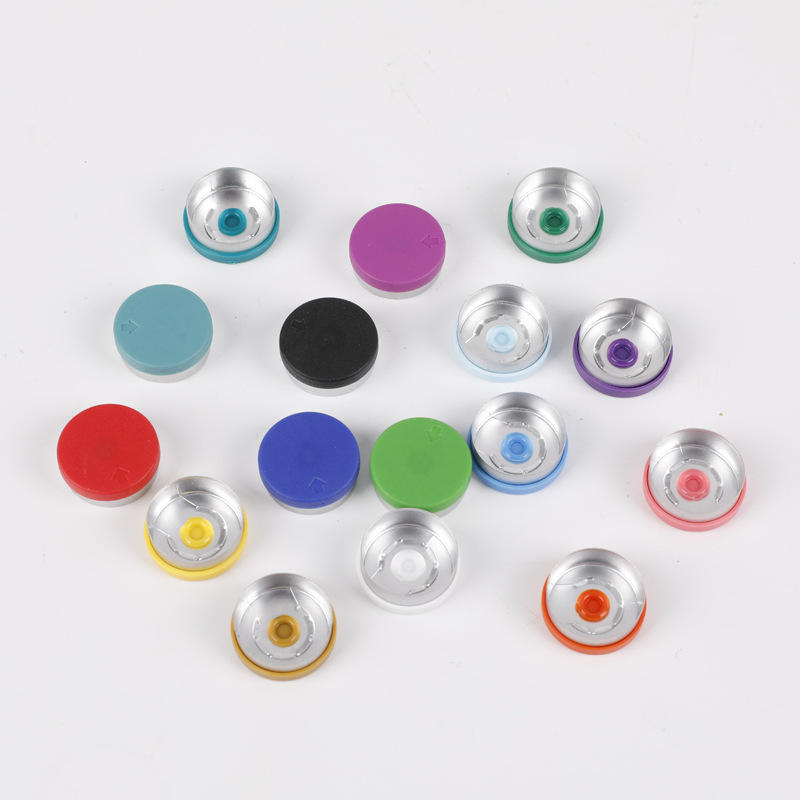
PharGlass offers customization across color, inner diameter, and inner height, accommodating vial sizes from 1ml to 25ml and beyond. This flexibility is particularly valuable for small pharma companies that have selected a vial configuration based on formulation needs rather than catalog convenience.
However, customization should be approached with discipline. Before requesting a custom cap, small pharma companies should confirm:
- The exact vial neck drawing, including tolerances
- The rubber stopper dimensions (flange diameter and height)
- The capping equipment model and jaw specifications
- The sterilization method (steam, gamma, EtO)
- Any tamper-evidence or color-coding requirements for the clinical setting
A custom cap is only as good as the data provided to the manufacturer. Suppliers who ask detailed technical questions before quoting are more likely to deliver a cap that works on the first trial run.
The “Single Source” Advantage: Why Buying Caps and Vials Together Reduces Risk
One of the most persistent challenges for small pharma is “tolerance stacking”—the accumulation of minor dimensional variations across components from different suppliers. A vial within specification, a stopper within specification, and a cap within specification can still fail to seal properly if the tolerances align in the worst-case direction.
Industry guidance consistently emphasizes that the vial, stopper, and cap should be evaluated as a complete container closure system, not as independent components . For small pharma companies without dedicated packaging engineering resources, this evaluation is difficult when each component comes from a different source.
PharGlass manufactures glass vials and supplies matching aluminum plastic caps as an integrated system. Because the caps are designed and dimensionally verified against PharGlass vial neck finishes, the risk of geometric mismatch is substantially reduced. This integration also simplifies documentation for regulatory submissions, as dimensional compatibility data can be provided for the complete system rather than pieced together from multiple suppliers.
What to Verify Before Placing Your First Order
For small pharma companies evaluating a cap supplier, the following checklist covers the practical essentials:
- Dimensional verification: Request batch-specific measurements for inner diameter, inner height, and skirt thickness, not just nominal specifications.
- Crimping trial: Where possible, request a small sample set for a trial on your actual capping equipment before committing to a production order.
- Material certification: Confirm the aluminum alloy grade and any plastic component material (typically polypropylene for the flip-off button).
- Sterilization compatibility: Verify that the cap and plastic button can withstand your sterilization cycle without deformation or color change.
- Regulatory documentation: Request compliance statements referencing ISO 8362-3 for aluminum caps, and confirmation that the cap is not considered a direct-contact primary packaging material requiring E&L assessment .
- Batch traceability: Ensure the supplier can link each shipment to production records for audit purposes.
Conclusion
For small pharma companies, the aluminum plastic cap is not a detail to be deferred until the end of packaging selection. It is the component that transforms a filled vial into a sealed, sterile, tamper-evident drug product. Choosing a supplier who understands the interaction between vial, stopper, and cap—and who can customize dimensions to match your specific system—reduces the risk of line stoppages, batch rejections, and regulatory queries.
PharGlass brings nearly 30 years of pharmaceutical glass manufacturing experience to the production of matching aluminum plastic caps. With customization available for color, inner diameter, and inner height, we support small pharma companies in achieving a validated closure system without the minimum order quantities typical of large-scale suppliers. To discuss your cap specifications or request samples for a crimping trial, contact our technical team.
Contact: sales@pharglass.com | Website: www.pharglass.com
Category: Application Guides

 EN
 FR
 AR
 DE
 ES
 PT
 FA
 RU