مقدمة
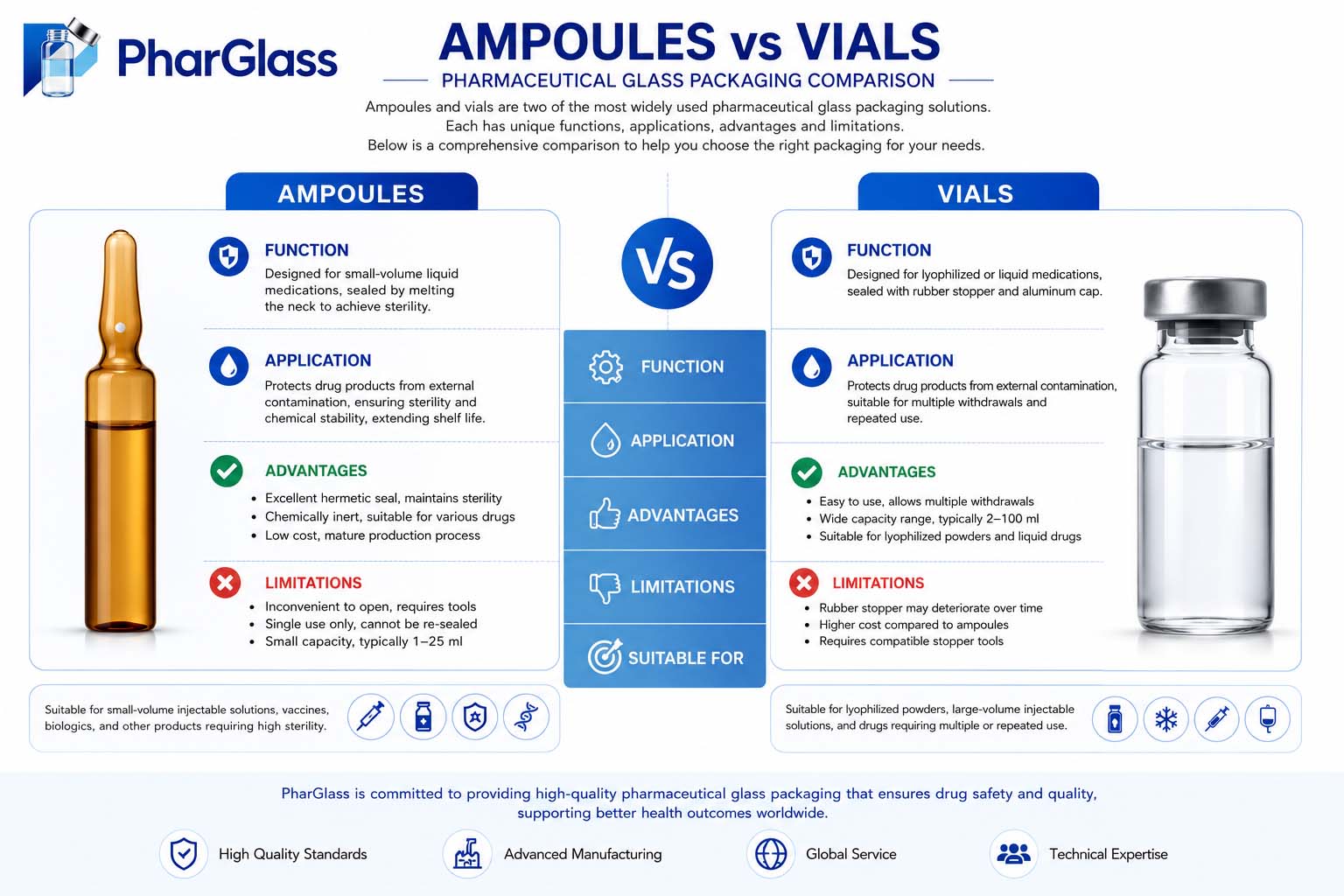
In parenteral drug packaging, two container formats dominate the global landscape: the injection vial (commonly known as the “Westar‑style vial” or simply “vial,” sealed with a rubber stopper and aluminum crimp cap) and the ampoule (a hermetically sealed glass container that is broken open at the neck). Although both are used for sterile injectable products, their design, performance, and application niches are fundamentally different.
Selecting the wrong format can lead to drug instability, dosing errors, increased production costs, or even regulatory compliance issues. This guide provides a complete, dimension‑by‑dimension comparison of vials and ampoules, based on industry standards (ISO 8362 for vials, ISO 9187 for ampoules), pharmacopoeial requirements (USP, EP, ChP), and current best practices in aseptic manufacturing.
تشنغتشو فار جلاس, a specialized supplier of advanced primary pharmaceutical packaging – including sterile glass vials, RTU rubber stoppers, and pre‑sterilized aluminum plastic caps – supports global pharmaceutical manufacturers in making informed container choices. Our technical team regularly advises clients on vial‑vs‑ampoule decisions based on drug formulation, filling line configuration, and target market regulations.
1. The Most Fundamental Difference: Sealing Structure
Ampoule: Flame‑Fused, All‑Glass Hermetic Seal
An ampoule is manufactured from a single piece of glass tubing. After filling, the neck is melted shut using a high‑temperature flame, creating a continuous glass wall with no rubber stopper, no aluminum cap, and no plastic component. A colored break‑ring (usually a blue dot or colored band) is pre‑scored onto the neck to indicate where to snap the glass open.
Advantages of the ampoule seal:
- Extremely low residual oxygen – because the glass is fused, no oxygen, water vapor, or any gas can enter or exit. For drugs that are highly susceptible to oxidation (e.g., epinephrine, ascorbic acid, certain vitamins), an ampoule provides the best possible protection.
- Zero elastomer‑related leachables – no rubber stopper means no risk of extractables from vulcanization agents (e.g., zinc, sulfur, mercaptobenzothiazoles) migrating into the drug product.
Disadvantages:
- Single‑use only – once opened, the entire contents must be used immediately. Any leftover drug is discarded.
- Glass particle generation – breaking the neck can produce invisible and visible glass fragments that may fall into the drug solution.
- User safety risk – sharp broken glass edges can injure healthcare workers.
Injection Vial (Vial): Stopper‑and‑Crimp Seal
A vial consists of three components: a glass container (tubular or molded), an elastomeric stopper (typically butyl or halobutyl rubber), and an aluminum or aluminum‑plastic overseal. The stopper is inserted into the vial neck, and the cap is crimped to compress the stopper against the glass sealing surface.
Advantages of the vial seal:
- Multi‑dose capability – a needle can pierce the stopper multiple times (modern stoppers are designed for up to 10–20 punctures with minimal coring). Unused drug can be stored for later use if the stopper maintains container closure integrity (CCI).
- No glass breakage during opening – the user simply removes the aluminum flip‑off cap (if present) or pierces directly through a stopper port.
- Safer for clinical staff – no sharp broken glass.
Disadvantages:
- Elastomer leachables – rubber stoppers release trace amounts of additives (sulfur, accelerators, lubricants) into the drug over time. For extremely sensitive drugs, this may be problematic.
- Long‑term micro‑permeability – although low, rubber‑sealed vials allow a very small amount of gas exchange (oxygen and water vapor). For drugs that require absolute anoxia, vials may not be sufficient without additional measures (e.g., nitrogen overlay).
2. Wall Thickness, Material Selection, and Glass Type
Ampoules: Thin‑Wall Tubular Glass
Ampoules are always made from glass tubing (not molded). The wall is intentionally thin to make snapping the neck easy and to reduce weight. The thin wall also improves heat transfer during flame sealing and sterilization.
Material trend:
Modern ampoules are predominantly Type I (mid‑borosilicate) glass according to USP <660> and EP 3.2.1. This is because the flame‑sealing process creates thermal stress, and low‑expansion borosilicate glass resists cracking. Many water‑for‑injection ampoules are also offered in Type I glass. Lower‑grade low‑borosilicate (Type II) ampoules exist but are less common for export or high‑value products.
Key properties:
- Coefficient of thermal expansion (CTE) ~3.3 × 10⁻⁶ /°C (Type I)
- Excellent thermal shock resistance for autoclaving
- Good clarity, but thin wall means less mechanical strength
Vials: Thicker Glass, Two Manufacturing Routes (Tubular and Molded)
Vials have significantly thicker walls than ampoules, providing mechanical robustness for transport, filling line handling, and freeze‑drying.
Tubular vials – Made from glass tubing similar to ampoules, but with thicker walls. Available in mid‑borosilicate (Type I) for biologics, vaccines, lyophilized products, or low‑borosilicate (Type II) for cost‑sensitive neutral injections. Tubular vials offer excellent dimensional precision and cosmetic appearance.
Molded vials – Formed by pressing molten glass into a mold. Most molded vials are low‑borosilicate or soda‑lime glass (Type III or Type II). They are thicker and cheaper but have lower chemical durability and wider dimensional tolerances. Molded vials are rarely used for high‑value parenterals but are common for oral liquids or large‑volume injections.
Why vials need thicker walls:
- Withstand the vacuum and thermal cycling of lyophilization (freeze‑drying) – typically from –40°C to +40°C repeatedly.
- Resist cracking during stoppering (the insertion of a rubber stopper exerts radial force on the glass neck).
- Survive transportation and handling without breakage.
3. Opening and Usage: Clinical Workflow Impact
| الميزة | Ampoule | Vial (Injection Vial) |
|---|---|---|
| Opening method | Snap neck at pre‑scored break‑ring | Remove flip‑off cap (or pierce directly) |
| Glass fragment risk | High – micro‑particles and visible shards can fall into solution | None – glass remains intact |
| User injury risk | Sharp edges can cut fingers | No sharp glass edges |
| Residual drug after opening | Discarded | Can be stored for next dose (if CCI maintained) |
| Medical waste category | Sharps container (puncture‑resistant) | Non‑sharps (regular pharmaceutical waste) |
Clinical observation: Many hospitals have shifted from ampoules to vials for routine injectables because of safety concerns. A 2021 study in the American Journal of Health‑System Pharmacy reported that ampoule‑related glass particle contamination occurs in 2–5% of manual openings, and finger lacerations account for a small but significant proportion of nursing injuries.
4. Drug Formulation Compatibility: Which Container for Which Product?
Ampoule Applications (Liquid Injections Only, Single Dose)
Ampoules are designed for ready‑to‑use liquid parenterals that are administered once and discarded. They cannot contain powders, lyophilized cakes, or any solid form – the flame‑sealing process would degrade solids.
Typical ampoule products:
- Water‑soluble vitamins (B complex, vitamin C) – often oxidation‑sensitive, so an oxygen‑free ampoule headspace is beneficial.
- Conventional small‑molecule water injections (e.g., lidocaine, diazepam, atropine).
- Light‑sensitive drugs (brown amber ampoules).
- Emergency drugs where single dose is standard (e.g., naloxone, epinephrine).
Ampoule capacity range: 1 mL, 2 mL, 5 mL, 10 mL, up to 20 mL (rarely larger because breaking becomes difficult).
Vial Applications (Liquids, Powders, Lyophilized Products, Multi‑Dose)
Vials are universal containers for sterile pharmaceuticals. The same vial geometry can be used for liquid fill, lyophilized powder, or a freeze‑dried cake that is reconstituted before injection.
Typical vial products:
- Lyophilized powders – vaccines, monoclonal antibodies, therapeutic proteins, peptide hormones (e.g., insulin in multi‑dose vials). The freeze‑drying process is performed inside the vial, with the stopper partially inserted for water vapor escape.
- Dry powder for injection – antibiotics such as ceftriaxone, ampicillin, meropenem (reconstituted with water for injection or diluent).
- Liquid biologics – where multiple doses are withdrawn from the same vial (e.g., heparin, erythropoietin).
- Large‑volume parenterals – irrigation solutions, IV bags (though vials are less common for >100 mL, where infusion bottles are used).
Vial capacity range: 2 mL to 100 mL (common sizes: 2R, 4R, 6R, 8R, 10R, 20R, 30R, 50R per ISO 8362‑1). Molded vials can go up to 500 mL.
Critical note: Vials are the only choice for freeze‑dried products because an ampoule’s thin wall and narrow neck cannot accommodate the ice sublimation process. The repeated thermal cycling from –40°C to +60°C during lyophilization would shatter most ampoules.
5. Cost and Manufacturing Considerations
| المعلمة | Ampoule | Vial (Injection Vial) |
|---|---|---|
| Glass material cost | Moderate (thin wall, less glass weight) | Lower per unit for molded vials; higher for tubular Type I |
| Filling line complexity | Requires flame sealing station (high energy, skill) | No flame; uses stopper insertion and crimping (more standard) |
| Sterility assurance | Very high – flame sealing creates an unbroken glass barrier | Very high when validated – but stopper insertion adds a potential contamination point |
| Unit price (typical) | 2–3× higher than a comparable molded vial for small sizes | Lower for high‑volume molded vials; Type I tubular vials similar to ampoules |
| Yield loss during filling | Higher due to sealing parameter variability | Lower – crimping is more consistent |
Key observation: Although individual ampoules have higher glass material cost, the overall filling line investment and maintenance for flame sealers can be significant. Many contract manufacturing organizations (CMOs) prefer vials because they do not require an on‑line glass melting station. However, for small‑volume, oxygen‑sensitive drugs, ampoules remain the gold standard.
6. Pros and Cons Summary Table
✅ Ampoule
| Advantages | Disadvantages |
|---|---|
| Hermetic seal – near‑zero oxygen transmission | Single‑use only – cannot be re‑sealed |
| No rubber stopper – zero elastomer leachables | Glass particles can enter drug upon opening |
| Ideal for oxidation‑sensitive liquids | Sharp edges – safety risk to healthcare workers |
| Excellent for export water injections | Cannot contain powders or lyophilized products |
| Light‑blocking (amber) available | Higher cost per dose for multi‑dose regimens |
✅ Vial (Injection Vial)
| Advantages | Disadvantages |
|---|---|
| Multi‑dose capability – drug can be used multiple times | Rubber stopper may release trace leachables |
| No glass breakage – safer for nurses and pharmacists | Very long‑term storage may see slight oxygen ingress |
| Compatible with lyophilization (freeze‑drying) | Stopper and cap add component complexity |
| Wide size range (1–100+ mL) | For extremely oxygen‑sensitive drugs, nitrogen overlay is required |
| Lower cost for high‑volume molded versions | – |
7. Quick Selection Guide – A Rule of Thumb
For liquid water injections that are oxidation‑sensitive, single‑dose, export‑focused, and do NOT require lyophilization → choose a Type I borosilicate ampoule.
For lyophilized powders, vaccines, multi‑dose formulations, antibiotics (powder for injection), or any product requiring freeze‑drying → choose a vial (injection vial), preferably Type I for biologics, Type II for neutral conventional drugs.
When in doubt, consider the following decision flow:
- Does the drug need to be freeze‑dried?
- Yes → Vial only (ampoule impossible).
- Is the drug a liquid that is extremely oxygen‑sensitive (e.g., epinephrine, sodium nitroprusside)?
- Yes → Ampoule, unless multi‑dose is clinically required (then vial with nitrogen overlay).
- Will the drug be used as a multi‑dose container in a hospital setting?
- Yes → Vial.
- Are you concerned about glass particles or user safety?
- Yes → Vial.
8. How Zhengzhou PharGlass Supports Your Container Decision
تشنغتشو فار جلاس provides advanced primary pharmaceutical packaging solutions for both vial and (in limited cases) ampoule supply chains – though our core expertise lies in sterile glass vials, RTU rubber stoppers, and pre‑sterilized aluminum plastic caps for modern aseptic filling lines.
We do not manufacture ampoules, but our technical team is frequently consulted by clients to determine whether a project is better suited for ampoules or vials. When the answer is vials – which is the case for the vast majority of biologics, vaccines, and lyophilized drugs – we deliver:
- Type I (mid‑borosilicate) tubular vials, fully compliant with ISO 8362‑1, USP <660>, and EP 3.2.1.
- Nest & tub or tray configurations, pre‑sterilized and ready‑to‑use (RTU), designed for integration into isolators, RABS, and robotic filling lines.
- Documented container closure integrity (CCI) data, extractables/leachables profiles, and sterility assurance level (SAL) validation.
For clients who must use ampoules for oxygen‑sensitive liquids, we can recommend qualified sources, but our own product focus remains on vial‑based systems – because the industry trend is overwhelmingly toward vials for their safety, flexibility, and compatibility with advanced aseptic processing.
9. Conclusion
The choice between an ampoule and a vial is not simply a technical preference – it is a strategic decision that affects drug stability, clinical safety, manufacturing efficiency, and regulatory acceptance. Ampoules offer unmatched hermeticity and zero stopper‑related leachables, making them ideal for single‑dose, oxidation‑sensitive liquid injections. Vials provide multi‑dose capability, lyophilization compatibility, and superior user safety, which is why they dominate the biologics, vaccine, and antibiotic powder markets.
تشنغتشو فار جلاس specializes in the vial‑based primary packaging system – including high‑quality sterile glass vials, RTU rubber stoppers, and pre‑sterilized aluminum plastic caps. Our products are engineered to meet the highest global standards, and our technical documentation supports your regulatory filings. If your next injectable product requires a reliable, validated vial system, we are ready to assist.
This article references ISO 8362‑1 (Injection vials), ISO 9187 (Ampoules), USP <660> Glass containers, EP 3.2.1, and GMP Annex 1 (2023) requirements for container closure integrity. Always conduct product‑specific compatibility studies.


 AR
AR  EN
EN  FR
FR  DE
DE  ES
ES  PT
PT  FA
FA  RU
RU