
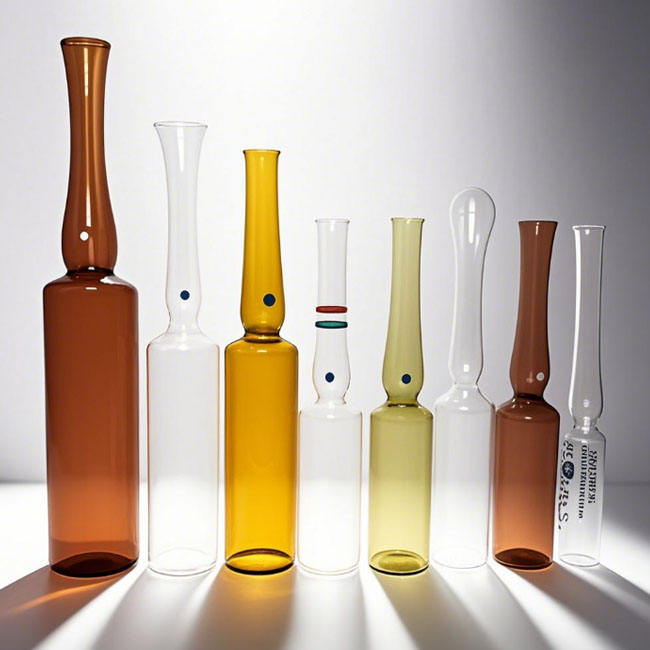
Middle Borosilicate Glass Ampoules: Technical Specifications and Performance Standards
Introduction
Middle borosilicate glass ampoules remain one of the most widely used primary packaging formats for injectable pharmaceuticals, vaccines, and biological products. Their popularity stems from a combination of chemical inertness, thermal stability, and precise dimensional control that supports high-speed filling lines and reliable clinical use. This article examines the technical specifications, material properties, and performance standards that define pharmaceutical-grade ampoules, with reference to YBB 00322005-2-2015 and equivalent international standards.
Material Composition and Glass Type
Middle borosilicate glass ampoules are produced from pharmaceutical-grade borosilicate glass tubing conforming to YBB 00012005-2-2015. Under the USP <660> classification system, borosilicate glass is designated as Type I glass, characterized by significant boric oxide (B₂O₃) and aluminum oxide content within the glass network. This composition delivers two critical advantages for pharmaceutical packaging: high hydrolytic resistance and high thermal shock resistance.
The linear thermal expansion coefficient of this glass ranges from (3.5–6.1) × 10⁻⁶ K⁻¹ at 20–300°C, a range that ensures compatibility with standard processing and sterilization procedures. For injectable drug products, Type I glass remains the primary packaging material of choice, as it minimizes the risk of alkali leaching and maintains chemical inertness throughout the product’s shelf life.
Shape and Breaking Mechanism Classification
Ampoules are configured according to two distinct classification systems.
By product shape, four forms exist:
- Form B — open stem
- Form C — open cup/funnel
- Form D — stem sealed dome
- Form E — stem sealed Marzocchi
By breaking mechanism, three categories exist:
- Color break-ring
- One-point-cut (OPC)
- Scoring and snapping
International standards provide the dimensional framework: ISO 9187-1:2010 specifies requirements for Forms B, C, and D, while ISO 9187-2:2010 governs one-point-cut (OPC) ampoules in Forms B, C, and D. These ISO standards address materials, dimensions, capacities, performance, and packaging requirements, with ampoules intended for single use only. The YBB standard aligns with these international requirements while incorporating domestic manufacturing parameters.
Key Technical Parameters
The dimensional accuracy of ampoules directly determines their compatibility with filling lines and the integrity of the final seal. The following table summarizes the critical control dimensions across the 1–25 ml capacity range.
| Parameter Category | Key Indicator | Technical Requirement |
|---|---|---|
| External Diameter | d₁ to d₄ (body / neck / bubble / stem) | Tolerance ±0.26 mm to ±1.0 mm; ampoules must satisfy d₁ > d₃ > d₂ > d₄ |
| Height | h₁ to h₆ (total to shoulder) | Tolerance ±1.0 mm to ±1.5 mm |
| Wall Thickness | S₂ (stem wall), S₃ (bottom) | Minimum 0.20 mm to 0.35 mm |
| Capacity | To shoulder (to neck) | 1.5 ml to 23.5 ml |
| Breaking Force | Peak force | 1 ml: 25–80 N; 5 ml: 30–80 N; 10 ml: 30–90 N; 20/25 ml: 30–100 N |
Safety and Performance Assurance
Breaking Force and Fracture Quality
The breaking force of an ampoule constitutes a critical safety parameter for clinical use. If the force required to snap the ampoule is excessive, the neck may shatter rather than fracture cleanly, potentially generating glass particles that contaminate the drug solution. Conversely, insufficient resistance can lead to premature breakage during handling or transport. International standards specify lower breaking force values than domestic standards, and validation studies indicate that products with lower breaking force values demonstrate higher pass rates for clean fracture surfaces.
Internal Stress Control
Internal stress control is equally important. The maximum permanent stress after annealing, measured as optical path difference, must not exceed 40 nm/mm. Excess residual stress significantly reduces mechanical strength, increasing the risk of breakage during filling, transport, or clinical use.
Hydrolytic Resistance
Hydrolytic resistance testing is performed in accordance with ISO 4802-2, which determines the amount of alkali metal oxides extracted from the glass surface under exposure to water at 121°C for 60 minutes using flame spectrometry. This test provides the basis for classifying glass containers according to their interior surface hydrolytic resistance. Middle borosilicate glass ampoules typically achieve HC1 grade, the highest classification for interior surface hydrolytic resistance.
Selection Considerations for Pharmaceutical Manufacturers
For pharmaceutical manufacturers, selection of middle borosilicate glass ampoules should consider:
- The specific drug formulation’s compatibility requirements (pH sensitivity, chelating agents, preservatives)
- Filling line specifications (dimensional tolerances, neck geometry)
- Regulatory requirements of the target market (USP, EP, JP, or YBB)
- Breaking force preferences for clinical end-users
The dimensional tolerances and performance parameters described above provide the technical foundation for evaluating ampoule quality against YBB 00322005-2-2015 and equivalent international standards.
 EN
 FR
 AR
 DE
 ES
 PT
 FA
 RU