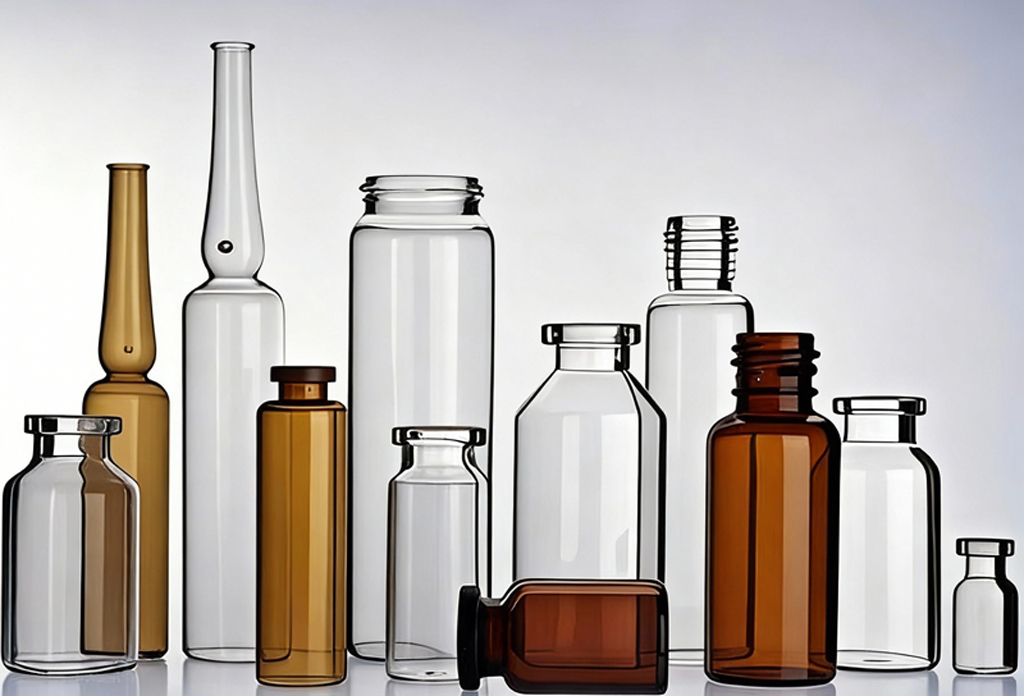
In the high-stakes landscape of parenteral drug manufacturing, the primary packaging container is far more than a simple vessel; it is an integral component of the drug product itself. For global pharmaceutical manufacturers, the selection of glass vials directly impacts drug stability, regulatory compliance, and patient safety. At Чжэнчжоу ФарГласс, we specialize in delivering advanced primary pharmaceutical packaging solutions, including high-quality sterile glass vials, ready-to-use (RTU) rubber stoppers, and pre-sterilized aluminum plastic caps. Our commitment to stringent quality control ensures seamless integration into your aseptic filling lines. This guide provides a comprehensive analysis of borosilicate glass types to assist procurement managers and formulation scientists in making informed decisions based on chemistry, thermal performance, and regulatory requirements.
The Critical Role of Glass Chemistry in Drug Stability
Pharmaceutical glass must be chemically inert. Any interaction between the glass surface and the drug product—such as ion leaching or delamination (glass flakes)—can compromise efficacy and safety. The industry standard, governed by the United States Pharmacopeia (USP), European Pharmacopoeia (EP), and the Chinese Pharmacopoeia (YBB standards), classifies glass into categories based on hydrolytic resistance. Чжэнчжоу ФарГласс focuses on supplying both Type I (Neutral Borosilicate) and Type II (Treated Soda-Lime or Low Borosilicate) glass containers to meet diverse global needs.
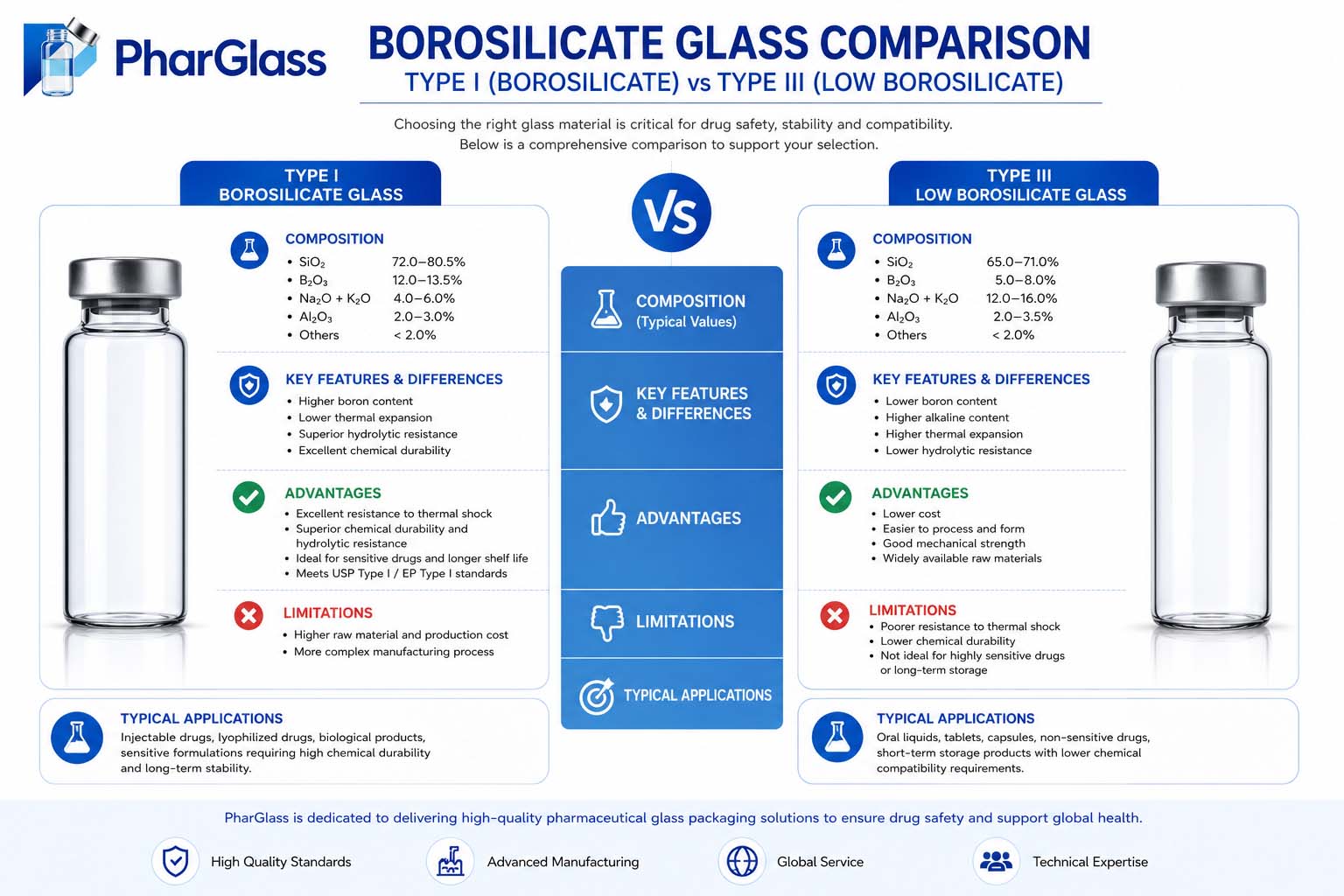
Composition Analysis: Type I vs. Type II Glass
The fundamental difference lies in the chemical composition, specifically the percentage of boron trioxide (B2O3) and alkali metals (sodium and potassium oxides). These elements dictate the glass’s physical and chemical behavior.
| Характеристика | Type I: Neutral Borosilicate (e.g., FIOLAX®) | Type II: Low Borosilicate / Treated Glass |
|---|---|---|
| B2O3Content | 8% – 13% (High Boron) | 5% – 8% (Low Boron) |
| Alkali Metal Oxides | < 7% (Very Low) | 8% – 11% (Higher) |
| Coefficient of Thermal Expansion | ~3.3 × 10⁻⁶/K | 4.5 – 6.5 × 10⁻⁶/K |
| Устойчивость к гидролизу | Class I (Highest) | Class II |
- Type I (Neutral Borosilicate): Often referred to as “neutral glass,” this material contains high levels of boron. This structure creates a tightly bound network that resists chemical attack.
- Type II (Low Borosilicate): This glass has a lower boron content and higher alkali metal content. While often treated with sulfur dioxide to improve surface durability, its bulk chemistry remains less stable than Type I.
Key Performance Differences for Pharmaceutical Applications
1. Chemical Stability: The Paramount Concern
Chemical inertness is the most critical factor for injectable drugs.
- Zhengzhou PharGlass Type I Advantage: Our Type I vials exhibit exceptional acid, alkali, and hydrolysis resistance. Even under aggressive conditions like 121°C autoclaving or long-term storage, these vials demonstrate minimal ion leaching (sodium, alkaline ions). This prevents изменение pH, glass delamination (“glass flakes”), and particulate formation (“white spots”), ensuring the drug remains uncontaminated throughout its shelf life.
- Type II Considerations: Due to higher alkali content, Type II glass is susceptible to ion leaching when exposed to extreme pH environments or prolonged heat. This can alter the drug’s pH and pose a risk of visible particles over time. However, Чжэнчжоу ФарГласс ensures that even our Type II vials meet YBB standards for stability in neutral environments (pH 5–8).
2. Thermal Shock Resistance
The manufacturing process often involves extreme temperature changes, such as sterilization, freezing, and lyophilization.
- Zhengzhou PharGlass Type I Advantage: With a low coefficient of thermal expansion (3.3), our borosilicate vials withstand rapid temperature shifts of 150°C to 200°C. They are engineered for the rigors of lyophilization (freeze-drying), transitioning from -40°C freezing to 60°C heating without cracking. Our data shows a breakage rate of less than 0.3% during lyophilization cycles.
- Type II Limitations: These vials typically tolerate temperature differences of only up to 70°C. In freeze-drying applications, the breakage rate can climb to approximately 2.7%. They are best suited for ambient filling and terminal sterilization via water bath.
3. Dimensional Precision and Aesthetics
- Type I: Offers superior clarity (crystal clear, no green tint), tighter dimensional tolerances (wall thickness, diameter), and better batch-to-batch consistency. This precision ensures optimal sealing integrity with Чжэнчжоу ФарГласс RTU rubber stoppers and aluminum caps.
- Type II: Easier to mold but often exhibits a slight greenish hue. Dimensional tolerances are generally wider, which may affect high-speed filling line efficiency if not sourced from a precision manufacturer like Чжэнчжоу ФарГласс.
4. Mechanical Strength and Cost
- Type I: Higher density offers better resistance to impact and shock. The drawback is cost; raw materials and precision tubing manufacturing make Type I vials 2.5 to 5 times more expensive than their Type II counterparts.
- Type II: The primary advantage is cost-effectiveness. Lower raw material costs and domestic production capacity make them ideal for high-volume, cost-sensitive generic drugs.
Краткий обзор преимуществ и недостатков
✅ Type I: Neutral Borosilicate (The Premium Choice)
Плюсы:
- Maximum Chemical Inertness: Essential for biologics, vaccines, and sensitive injectables. It is the mandatory choice for drugs undergoing Consistency Evaluation in China and FDA/EMA approval globally.
- Extreme Temperature Tolerance: The only suitable choice for lyophilization, pre-filled syringes, and cartridge systems.
- Long-Term Shelf Life: Guarantees drug stability for 2–5 years without risk of contamination.
- Глобальное соответствие: Meets USP <660>, EP 3.2.1, and YBB standards, facilitating worldwide export.
Недостатки:
- Higher procurement cost and longer lead times for specific customizations.
Идеальное применение:
- Vaccines & Biologics: mRNA vaccines, monoclonal antibodies (mAbs).
- Lyophilized Powders: Injectable powders requiring reconstitution.
- Specialty Injectables: Drugs with pH < 4 or > 9.
- Export Products: Any drug intended for regulated markets (USA, EU, Japan).
✅ Type II: Low Borosilicate (The Cost-Effective Choice)
Плюсы:
- Economic Efficiency: Significantly lowers packaging costs for high-volume products.
- Regulatory Compliance: Fully compliant with YBB standards for non-critical applications.
- Supply Chain Agility: High domestic capacity allows for faster delivery and flexible order quantities from Чжэнчжоу ФарГласс.
Недостатки:
- Not suitable for strong acids/bases or freeze-drying. Risk of delamination in long-term storage of sensitive formulations.
Идеальное применение:
- General Antibiotics: Cephalosporins, Penicillins.
- Oral Liquids: Syrups and suspensions.
- Topical Solutions: Tinctures and external use.
- Solid Dose Packaging: Tablets and granules.
Integration with Zhengzhou PharGlass Packaging Systems
Selecting the right vial is only half the battle. To ensure a truly sterile barrier, Чжэнчжоу ФарГласс provides a complete, compatible packaging system. Our Ready-to-Use (RTU) Rubber Stoppers are washed and sterilized, designed to match the exact specifications of our vials to prevent leakage and maintain vacuum. Paired with our Pre-sterilized Aluminum Plastic Caps, we offer a one-stop solution that minimizes your incoming quality control burden.
Selection Guide: Making the Right Choice
To simplify your procurement process, follow this expert guideline:
- Choose Type I (Neutral Borosilicate) if: Your product is a vaccine, biologic, lyophilized powder, or has an extreme pH. If you are exporting to international markets, Type I is non-negotiable.
- Choose Type II (Low Borosilicate) if: You are producing standard antibiotics, oral liquids, or general injectables with a neutral pH and require maximum cost efficiency for the domestic market.
Why Choose Zhengzhou PharGlass?
На сайте Чжэнчжоу ФарГласс, we don’t just supply glass; we provide packaging assurance. Our facilities adhere to ISO 15378 (GMP for primary packaging materials) standards. By controlling the entire process—from glass tubing selection to washing, depyrogenation, and sterilization—we ensure that every vial, stopper, and cap delivered to your facility meets the highest standards of cleanliness and performance.
Our expertise in both Type I and Type II glass allows us to consult with you on the optimal balance between performance and budget. Whether you require the ultimate protection of neutral borosilicate for a novel biologic or the economic efficiency of low borosilicate for a generic antibiotic, Чжэнчжоу ФарГласс is your trusted partner for global pharmaceutical excellence. Contact our technical team today to request samples and validate your packaging system.
 RU
RU  EN
EN  FR
FR  AR
AR  DE
DE  ES
ES  PT
PT  FA
FA