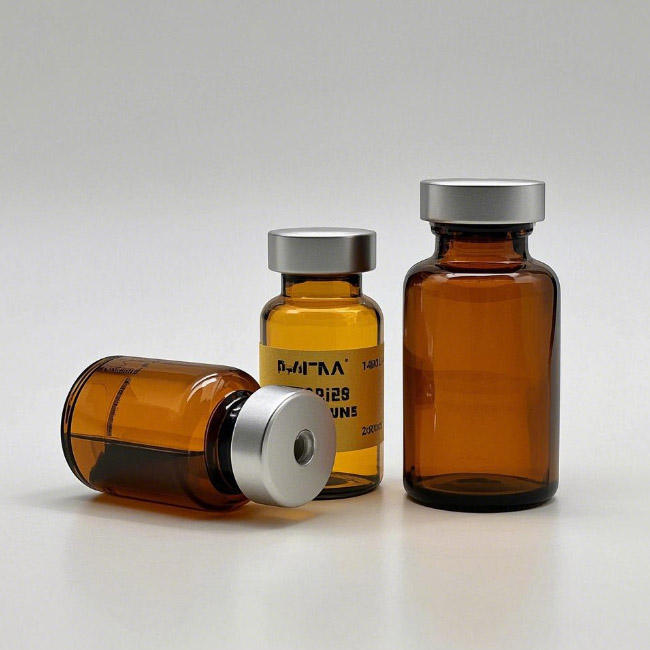
In the realm of pharmaceutical packaging, vials are indispensable for storing injectables, vaccines, biologics, and other sterile medications. The integrity of these vials—ensuring sterility, stability, and security—relies heavily on their sealing systems. PharGlass, a leading global supplier of pharmaceutical packaging materials, specializes in high-quality glass vials, rubber stoppers, and aluminum-plastic caps. Our expertise lies in combining these components into a robust, multi-functional sealing solution that meets the stringent demands of modern pharmaceutical manufacturing. This article explores the science and engineering behind vial sealing, emphasizing how PharGlass’s rubber stoppers and aluminum caps work in synergy to deliver unmatched performance.
1. Core Role of Rubber Stoppers: The Foundation of Dynamic Sealing
Rubber stoppers are the “heart” of vial sealing, addressing critical challenges like dynamic sealing (e.g., during needle puncture) and chemical compatibility. At PharGlass, our rubber stoppers are engineered to excel in four key areas:
a. Exceptional Sealability
Rubber’s inherent elasticity and plasticity allow it to conform tightly to the inner walls of vial necks. Even under temperature fluctuations or minor vibrations (common during transportation or storage), our stoppers maintain a hermetic seal, preventing air, moisture, and microbes from entering the vial. This is vital for preserving the efficacy of oxygen-sensitive drugs (e.g., biologics, vaccines) and preventing contamination.
b. High Chemical Stability
PharGlass uses pharmaceutical-grade rubber (e.g., butyl rubber) that undergoes specialized treatments like siliconization and sterilization. These processes enhance chemical inertness, ensuring the stopper does not react with the drug formulation or leach harmful substances. For injectables and biologics—where purity is non-negotiable—this chemical stability is a game-changer. Studies in pharmaceutical technology confirm that butyl rubber’s low extractable profile makes it ideal for high-purity applications (Journal of Pharmaceutical Sciences, 2022).
c. Puncture Compatibility & Self-Closure
A standout feature of PharGlass rubber stoppers is their ability to withstand needle puncture and rapidly self-close afterward. When a syringe needle penetrates the stopper, the rubber’s toughness prevents tearing, while its elastic recoil seals the puncture site. This reduces the risk of drug leakage and external contamination—advantages that glass stoppers (prone to breakage) and metal stoppers (poor post-puncture sealing) cannot match.
2. Core Role of Aluminum Caps: The Backbone of Static Fixation & Protection
Aluminum caps serve as the “exoskeleton” of the vial, complementing the rubber stopper’s dynamic sealing with static fixation, physical protection, and anti-tampering features. PharGlass’s aluminum caps are designed to:
a. Secure the Rubber Stopper
Aluminum’s malleability allows our caps to be mechanically crimped around the vial neck and stopper edge, preventing the stopper from loosening due to pressure changes (e.g., during autoclaving) or transportation vibrations. This reinforces the seal’s reliability, especially in large-scale manufacturing and distribution.
b. Provide Physical Barrier & Sterility
The aluminum cap acts as a secondary physical barrier, shielding the rubber stopper from dust, debris, and direct contact with contaminants. In processes like steam sterilization (e.g., moist heat sterilization) or long-term storage, this “double protection” (rubber + aluminum) maintains a sterile environment inside the vial. Research in packaging technology highlights that aluminum’s barrier properties (against light, moisture, and particulates) are critical for preserving drug stability (Packaging Technology and Science, 2021).
c. Anti-Opening & Traceability
PharGlass aluminum caps offer tamper-evident and anti-opening functionality. Once crimped, the cap resists unauthorized removal, reducing the risk of product tampering. Additionally, the cap surface can be printed with batch numbers, expiration dates, and other critical information—facilitating traceability and compliance with regulatory standards (e.g., FDA, EMA).
3. Synergy of Combined Sealing: A Holistic Approach to Vial Integrity
The magic of PharGlass’s vial packaging lies in the synergy between rubber stoppers and aluminum caps:
- Dynamic vs. Static Sealing: Rubber stoppers address dynamicneeds (puncture, chemical compatibility), while aluminum caps address staticneeds (fixation, physical protection). This division of labor ensures no single point of failure.
- Complementary Strengths: Rubber’s elasticity solves sealing challenges during use (e.g., multiple punctures for multi-dose vials), while aluminum’s rigidity ensures long-term stability during storage and transport.
- Regulatory & Practical Validation: This combination is a time-tested, efficient solution for sterile pharmaceuticals (e.g., injectables, vaccines). It meets global regulatory requirements (e.g., USP <671>, EP 3.2) and has been validated by decades of industry practice.
PharGlass: Your Trusted Partner for Pharmaceutical Packaging Excellence
At PharGlass, we don’t just supply components—we engineer solutions. Our glass vials, rubber stoppers, and aluminum-plastic caps are designed to work in harmony, ensuring:
- Uncompromising Sterility: Protecting sensitive formulations from contamination.
- Exceptional Stability: Preserving drug efficacy over time.
- Operational Efficiency: Enabling smooth filling, sterilization, and administration.
With OEM/ODM support, rigorous quality control, and reliable global delivery, PharGlass empowers pharmaceutical manufacturers to meet the demands of today’s market—from small-batch biologics to large-scale vaccine production. Our commitment to innovation and quality has made us a preferred partner for companies worldwide.
Conclusion: The Future of Vial Packaging with PharGlass
As the pharmaceutical industry evolves—with trends like personalized medicine, cold-chain logistics, and stricter regulations—the need for advanced vial packaging grows. PharGlass’s rubber stopper-aluminum cap combination is more than a solution; it’s a standard for excellence. By leveraging the unique strengths of rubber and aluminum, we deliver packaging that safeguards your products, complies with global standards, and supports your brand’s reputation.
Whether you’re developing a new biologic, scaling up vaccine production, or optimizing injectable packaging, PharGlass has the expertise and solutions to elevate your success. Contact us today to discover how our pharmaceutical packaging materials can transform your manufacturing process.
 EN
EN  FR
FR  AR
AR  DE
DE  ES
ES  PT
PT  FA
FA  RU
RU