
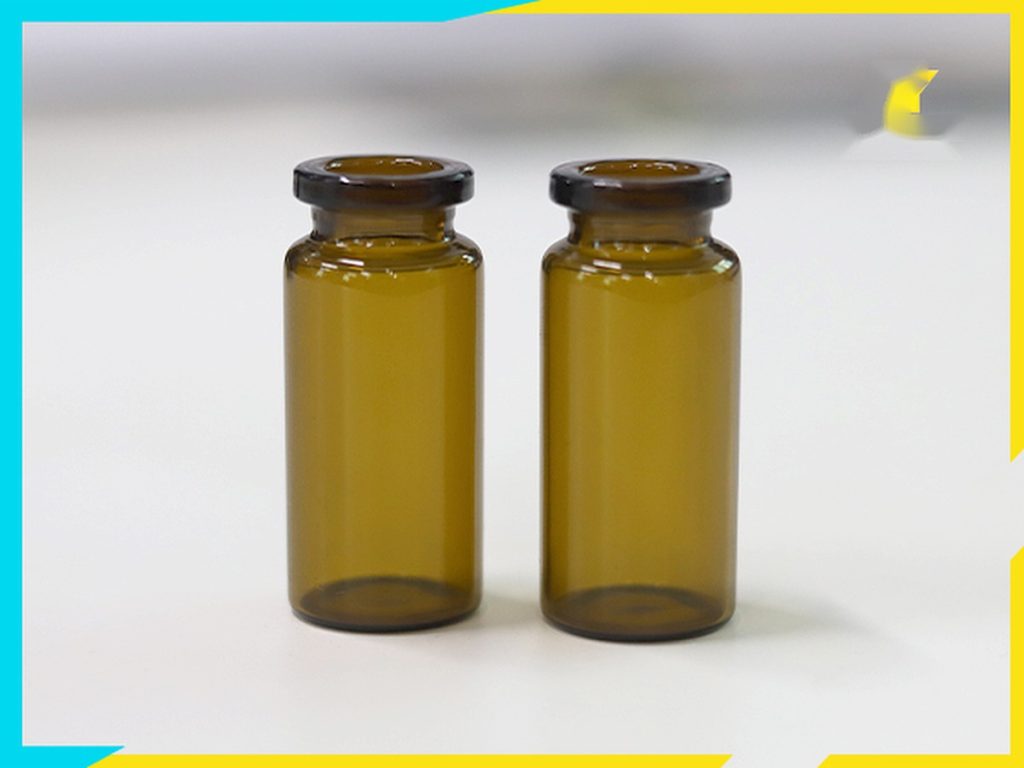
Oral liquid bottles are made by two different processes, and the choice affects cost, capacity range, dimensional consistency and the minimum order you have to commit to. Most buyers compare price per bottle without realising that the two processes serve different parts of the market.
Tubular bottles
Tubular bottles are formed from pre-drawn glass tubing. The tube is cut to length, heated and shaped into a bottle on a rotary machine. Because the starting material is already a controlled tube, the wall thickness and bore are relatively uniform, and the neck finish can be held to tight tolerances.
Tubular production is well suited to small and medium capacities — roughly 5 ml to 50 ml — and to shorter runs. Tooling is comparatively modest, which makes it practical for a new product, a sample pack or a regional launch that cannot absorb the cost of mould tooling.
Moulded bottles
Moulded bottles are formed from a gob of molten glass pressed or blown in a metal mould. The process is efficient at larger capacities — roughly 10 ml to 500 ml and beyond — and at high volumes, because the mould cost is spread across a long production run.
The trade-off is that wall thickness and weight vary more than in tubular bottles, and the neck finish depends on mould wear. For a premium pharmaceutical product with a child-resistant closure, that variation has to be controlled by the mould maintenance schedule rather than by the forming process itself.
Side-by-side comparison
| العامل | Tubular | Moulded |
|---|---|---|
| Typical capacity | 5–50 ml | 10–500 ml |
| Wall uniformity | مرتفع | Moderate |
| Tooling cost | أقل | أعلى |
| Economic run size | Small to medium | Medium to large |
| Neck finish control | Tight | Depends on mould wear |
| Decoration | Easy on small diameters | Better for large surfaces |
Which should you specify?
Start from the fill volume and the annual quantity. If you need 10–30 ml in a run of tens of thousands, tubular is usually the better fit. If you need 100–250 ml in a run of hundreds of thousands, moulded is usually cheaper per unit. If the product sits between the two, ask for both quotations rather than assuming one process is always cheaper.
The closure should be chosen with the bottle. A crimp neck and a screw neck are not interchangeable, and the neck finish tolerance of the chosen process determines how reliably the cap seals.
مقالات ذات صلة
- Oral liquid glass bottles
- Oral liquid bottle sizes and neck finishes
- Crimp neck vs screw neck bottles
Send your capacity and annual volume to فريق المبيعات لدينا and we will quote the process that fits.

 AR
 EN
 FR
 DE
 ES
 PT
 FA
 RU