Einleitung
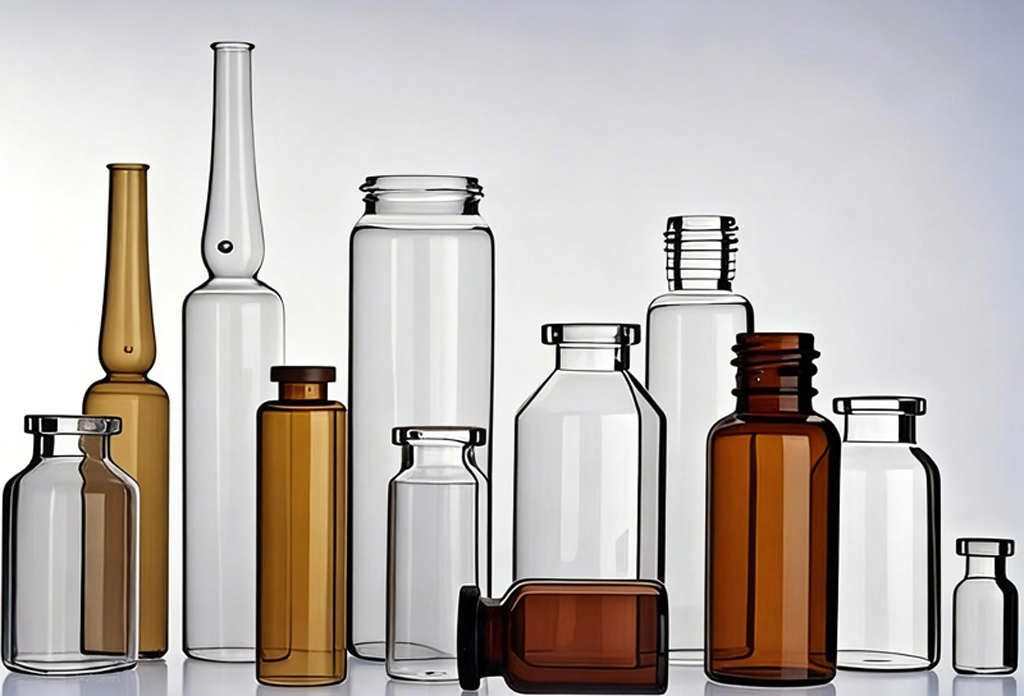
Bei der Verpackung von parenteralen Arzneimitteln dominieren weltweit zwei Behälterformate: die Injektionsampulle (allgemein bekannt als “Westar-Fläschchen” oder einfach “Fläschchen”, verschlossen mit einem Gummistopfen und einer Aluminium-Crimpkappe) und die Ampulle (ein hermetisch verschlossener Glasbehälter, der am Hals aufgebrochen wird). Obwohl beide für sterile Injektionspräparate verwendet werden, unterscheiden sich ihre Konstruktion, ihre Leistungsmerkmale und ihre Anwendungsbereiche grundlegend voneinander.
Die Wahl des falschen Formats kann zu einer Instabilität des Arzneimittels, zu Dosierungsfehlern, erhöhten Produktionskosten oder sogar zu Problemen bei der Einhaltung gesetzlicher Vorschriften führen. Dieser Leitfaden bietet einen vollständigen, maßgenauen Vergleich von Fläschchen und Ampullen auf der Grundlage von Industriestandards (ISO 8362 für Fläschchen, ISO 9187 für Ampullen), den Anforderungen der Arzneibücher (USP, EP, ChP) sowie den aktuellen Best Practices in der aseptischen Herstellung.
Zhengzhou PharGlass, ein spezialisierter Anbieter von hochmodernen Primärverpackungen für Arzneimittel – darunter sterile Glasfläschchen, gebrauchsfertige Gummistopfen und vorsterilisierte Aluminium-Kunststoff-Verschlüsse – unterstützt globale Pharmahersteller dabei, fundierte Entscheidungen bei der Auswahl von Verpackungsbehältern zu treffen. Unser technisches Team berät Kunden regelmäßig bei der Entscheidung zwischen Fläschchen und Ampullen unter Berücksichtigung der Arzneimittelformulierung, der Konfiguration der Abfüllanlage und der Vorschriften des Zielmarktes.
1. Der grundlegendste Unterschied: Die Dichtungsstruktur
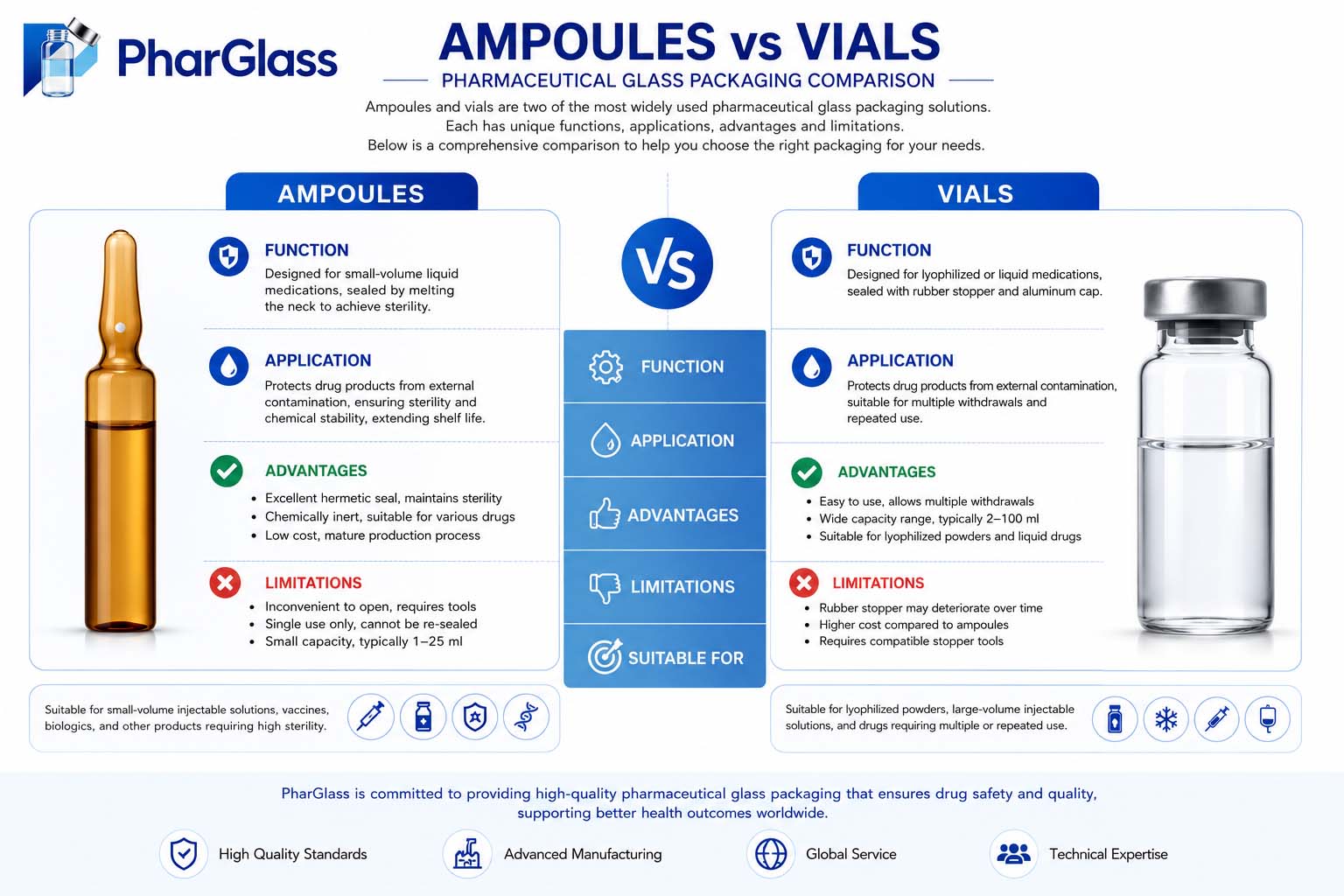
Ampulle: Flammverschmolzen, hermetischer Vollglasverschluss
Eine Ampulle wird aus einem einzigen Stück Glasrohr hergestellt. Nach dem Befüllen wird der Hals mit einer Hochtemperaturflamme verschweißt, wodurch eine durchgehende Glaswand entsteht – ganz ohne Gummistopfen, Aluminiumkappe oder Kunststoffteile. Am Flaschenhals ist eine farbige Bruchmarkierung (in der Regel ein blauer Punkt oder ein farbiges Band) vorgestanzt, die anzeigt, wo das Glas aufgebrochen werden muss.
Vorteile des Ampullenverschlusses:
- Extrem niedriger Restsauerstoffgehalt – Da das Glas verschmolzen ist, können weder Sauerstoff noch Wasserdampf noch andere Gase eindringen oder entweichen. Für Arzneimittel, die besonders anfällig für Oxidation sind (z. B. Adrenalin, Ascorbinsäure, bestimmte Vitamine), bietet eine Ampulle den bestmöglichen Schutz.
- Keine aus Elastomeren stammenden Auslaugstoffe – Da kein Gummistopfen verwendet wird, besteht keine Gefahr, dass aus Vulkanisationsmitteln stammende extrahierbare Stoffe (z. B. Zink, Schwefel, Mercaptobenzothiazole) in das Arzneimittel übergehen.
Nachteile:
- Nur zum einmaligen Gebrauch – Nach dem Öffnen muss der gesamte Inhalt sofort aufgebraucht werden. Etwaige Arzneimittelreste sind zu entsorgen.
- Entstehung von Glaspartikeln – Beim Brechen des Halses können unsichtbare und sichtbare Glassplitter entstehen, die in die Medikamentenlösung gelangen können.
- Sicherheitsrisiko für den Benutzer – Scharfe Glasscherben können das medizinische Personal verletzen.
Injektionsfläschchen (Fläschchen): Verschluss mit Stopfen und Crimpversiegelung
Eine Ampulle besteht aus drei Komponenten: einem Glasbehälter (rohrförmig oder geformt), einem Elastomerstopfen (in der Regel aus Butyl- oder Halobutylkautschuk) und einer Versiegelungskappe aus Aluminium oder einer Aluminium-Kunststoff-Kombination. Der Stopfen wird in den Flaschenhals eingesetzt, und die Kappe wird verpresst, um den Stopfen gegen die Glasdichtfläche zu drücken.
Vorteile der Fläschchenversiegelung:
- Fähigkeit zur Mehrfachdosierung – Eine Nadel kann den Stopfen mehrmals durchstechen (moderne Stopfen sind für bis zu 10–20 Einstiche bei minimalem Kernverlust ausgelegt). Nicht verwendete Arzneimittel können für den späteren Gebrauch aufbewahrt werden, sofern der Stopfen die Integrität des Behälterverschlusses (CCI) gewährleistet.
- Beim Öffnen entsteht kein Glasbruch – Der Benutzer entfernt einfach den Aluminium-Abziehverschluss (falls vorhanden) oder sticht direkt durch eine Öffnung im Stopfen.
- Mehr Sicherheit für das klinische Personal – keine scharfen Glasscherben.
Nachteile:
- Aus Elastomeren freigesetzte Stoffe – Gummistopfen geben im Laufe der Zeit Spuren von Zusatzstoffen (Schwefel, Beschleuniger, Gleitmittel) an das Arzneimittel ab. Bei äußerst empfindlichen Arzneimitteln kann dies problematisch sein.
- Langfristige Mikropermeabilität – Auch wenn sie gering ist, lassen gummidichtete Fläschchen einen sehr geringen Gasaustausch (Sauerstoff und Wasserdampf) zu. Bei Arzneimitteln, die absolute Sauerstofffreiheit erfordern, reichen Fläschchen ohne zusätzliche Maßnahmen (z. B. Stickstoffüberzug) möglicherweise nicht aus.
2. Wandstärke, Materialauswahl und Glasart
Ampullen: Dünnwandiges Röhrenglas
Ampullen werden immer aus Glasrohr (nicht geformt). Die Wand ist bewusst dünn gehalten, um das Abbrechen des Halses zu erleichtern und das Gewicht zu reduzieren. Die dünne Wand verbessert zudem die Wärmeübertragung beim Flammversiegeln und bei der Sterilisation.
Materialtrend:
Moderne Ampullen bestehen überwiegend aus Glas vom Typ I (Mitteltemperatur-Borosilikatglas) gemäß USP und EP 3.2.1. Der Grund dafür ist, dass beim Flammversiegelungsverfahren thermische Spannungen entstehen und Borosilikatglas mit geringer Ausdehnung rissbeständig ist. Viele Ampullen für Wasser zur Injektion werden auch aus Glas Typ I angeboten. Es gibt zwar Ampullen aus Borosilikatglas mit geringerem Borgehalt (Typ II), diese werden jedoch für den Export oder für hochwertige Produkte seltener verwendet.
Wichtigste Eigenschaften:
- Wärmeausdehnungskoeffizient (CTE) ~3,3 × 10⁻⁶ /°C (Typ I)
- Hervorragende Temperaturwechselbeständigkeit beim Autoklavieren
- Gute Klarheit, aber die dünne Wand führt zu einer geringeren mechanischen Festigkeit
Fläschchen: Dickeres Glas, zwei Herstellungsverfahren (Rohrohr- und Formverfahren)
Fläschchen haben deutlich dickere Wände als Ampullen und bieten somit eine hohe mechanische Robustheit für den Transport, die Handhabung in der Abfüllanlage und die Gefriertrocknung.
Röhrchen – Hergestellt aus Glasröhrchen, ähnlich wie Ampullen, jedoch mit dickeren Wänden. Erhältlich in Mittleres Borosilikatglas (Typ I) für Biologika, Impfstoffe, gefriergetrocknete Produkte oder borosilikatarm (Typ II) für kostengünstige, neutrale Abfüllungen. Röhrenförmige Fläschchen zeichnen sich durch hervorragende Maßgenauigkeit und ein ansprechendes Erscheinungsbild aus.
Formgepresste Fläschchen – Durch Pressen von geschmolzenem Glas in eine Form hergestellt. Die meisten geformten Fläschchen sind Glas mit niedrigem Borosilikat- oder Kalk-Natron-Gehalt (Typ III oder Typ II). Sie sind dicker und kostengünstiger, weisen jedoch eine geringere chemische Beständigkeit und größere Maßtoleranzen auf. Geformte Fläschchen werden selten für hochwertige Parenteralia verwendet, sind jedoch bei oralen Flüssigkeiten oder großvolumigen Injektionen weit verbreitet.
Warum Fläschchen dickere Wände benötigen:
- Sie müssen dem Vakuum und den Temperaturwechseln bei der Gefriertrocknung standhalten – typischerweise wiederholt von –40 °C bis +40 °C.
- Beständigkeit gegen Rissbildung beim Verschließen (das Einsetzen eines Gummistopfens übt eine radiale Kraft auf den Glashals aus).
- Den Transport und die Handhabung unbeschadet überstehen.
3. Inbetriebnahme und Nutzung: Auswirkungen auf den klinischen Arbeitsablauf
| Merkmal | Ampulle | Fläschchen (Injektionsfläschchen) |
|---|---|---|
| Öffnungsmethode | Den Hals an der vorgestanzten Bruchstelle abbrechen | Abziehverschluss entfernen (oder direkt durchstechen) |
| Gefahr durch Glassplitter | Hoch – Mikropartikel und sichtbare Splitter können in die Lösung gelangen | Keine – das Glas bleibt unversehrt |
| Verletzungsrisiko für den Benutzer | Scharfe Kanten können zu Schnittverletzungen an den Fingern führen | Keine scharfen Glaskanten |
| Arzneimittelreste nach dem Öffnen | Verworfen | Kann für die nächste Dosis aufbewahrt werden (sofern die CCI aufrechterhalten bleibt) |
| Kategorie medizinischer Abfälle | Behälter für scharfe Gegenstände (durchstoßfest) | Nicht-scharfe Gegenstände (gewöhnlicher Arzneimittelabfall) |
Klinische Beobachtung: Viele Krankenhäuser sind aus Sicherheitsgründen bei Routinemedikamenten zur Injektion von Ampullen auf Fläschchen umgestiegen. Eine Studie aus dem Jahr 2021 in der American Journal of Health-System Pharmacy Es wurde berichtet, dass es bei 2–51 TP3T der manuellen Öffnungen zu einer Kontamination durch Glaspartikel aus Ampullen kommt und dass Schnittverletzungen an den Fingern einen geringen, aber signifikanten Anteil der Verletzungen im Pflegebereich ausmachen.
4. Kompatibilität von Arzneimittelformulierungen: Welcher Behälter für welches Produkt?
Anwendungen mit Ampullen (nur Flüssigkeitsinjektionen, Einzeldosis)
Ampullen sind bestimmt für gebrauchsfertige flüssige Parenteralia die einmal verabreicht und anschließend entsorgt werden. Sie kann nicht die Pulver, gefriergetrocknete Kuchen oder sonstige feste Stoffe enthalten – würde das Flammversiegelungsverfahren die festen Stoffe zersetzen.
Typische Ampullenprodukte:
- Wasserlösliche Vitamine (B-Komplex, Vitamin C) – sind oft oxidationsempfindlich, daher ist ein sauerstofffreier Kopfraum in der Ampulle von Vorteil.
- Herkömmliche Injektionen von niedermolekularen Substanzen (z. B. Lidocain, Diazepam, Atropin).
- Lichtempfindliche Arzneimittel (braune, bernsteinfarbene Ampullen).
- Notfallmedikamente, bei denen eine Einzeldosis die Regel ist (z. B. Naloxon, Adrenalin).
Fassungsvermögen der Ampullen: 1 ml, 2 ml, 5 ml, 10 ml, bis zu 20 ml (selten größer, da das Brechen dann schwierig wird).
Anwendungen für Fläschchen (Flüssigkeiten, Pulver, gefriergetrocknete Produkte, Mehrfachdosen)
Fläschchen sind Universalkontainer für sterile Arzneimittel. Die gleiche Fläschchenform kann für Flüssigfüllungen, gefriergetrocknetes Pulver oder einen gefriergetrockneten Kuchen verwendet werden, der vor der Injektion rekonstituiert wird.
Typische Produkte in Fläschchen:
- Gefriergetrocknete Pulver – Impfstoffe, monoklonale Antikörper, therapeutische Proteine, Peptidhormone (z. B. Insulin in Mehrfachdosenampullen). Der Gefriertrocknungsprozess findet im Inneren der Ampulle statt, wobei der Stopfen teilweise eingesetzt ist, damit Wasserdampf entweichen kann.
- Trockenpulver zur Injektion – Antibiotika wie Ceftriaxon, Ampicillin, Meropenem (mit Wasser für Injektionszwecke oder Verdünnungsmittel rekonstituiert).
- Flüssige Biologika – wenn mehrere Dosen aus derselben Ampulle entnommen werden (z. B. Heparin, Erythropoetin).
- Parenterale Präparate mit großem Volumen – Infusionslösungen, Infusionsbeutel (wobei Ampullen bei Volumina von mehr als 100 ml seltener zum Einsatz kommen; hier werden Infusionsflaschen verwendet).
Fläschchen-Fassungsvermögen: 2 ml bis 100 ml (gängige Größen: 2R, 4R, 6R, 8R, 10R, 20R, 30R, 50R gemäß ISO 8362-1). Geformte Fläschchen sind bis zu 500 ml erhältlich.
Anmerkung: Fläschchen sind die die einzige Wahl für gefriergetrocknete Produkte da die dünne Wand und der schmale Hals einer Ampulle den Prozess der Eissublimation nicht zulassen. Die wiederholten Temperaturwechsel von –40 °C auf +60 °C während der Gefriertrocknung würden die meisten Ampullen zerbrechen lassen.
5. Überlegungen zu Kosten und Fertigung
| Parameter | Ampulle | Fläschchen (Injektionsfläschchen) |
|---|---|---|
| Kosten für Glasmaterial | Mäßig (dünne Wandstärke, geringeres Glasgewicht) | Niedrigerer Stückpreis für geformte Fläschchen; höherer Preis für röhrenförmige Fläschchen vom Typ I |
| Komplexität der Abfüllanlage | Erfordert eine Flammversiegelungsstation (hohe Energie, Fachkenntnisse) | Keine Flamme; erfolgt durch Einführen und Crimpen des Verschlusses (üblicher) |
| Sterilitätssicherung | Sehr hoch – durch die Flammversiegelung entsteht eine durchgehende Glasbarriere | Bei Validierung sehr hoch – das Einsetzen des Verschlusses stellt jedoch eine potenzielle Kontaminationsquelle dar |
| Stückpreis (typisch) | 2–3-mal höher als bei einer vergleichbaren Spritzgussampulle in kleinen Größen | Niedriger bei in großen Stückzahlen geformten Fläschchen; röhrenförmige Fläschchen vom Typ I, ähnlich wie Ampullen |
| Ertragsverlust während der Reifung | Höher aufgrund von Schwankungen bei den Dichtungsparametern | Niedriger – das Crimpen erfolgt gleichmäßiger |
Wichtigste Erkenntnis: Zwar sind die Materialkosten für Glas bei einzelnen Ampullen höher, doch können die Gesamtinvestitionskosten für die Abfüllanlage sowie die Wartungskosten für Flammversiegelungsanlagen erheblich sein. Viele Auftragsfertiger (CMOs) bevorzugen Fläschchen, da hierfür keine integrierte Glasschmelzanlage erforderlich ist. Bei Arzneimitteln mit geringem Volumen, die sauerstoffempfindlich sind, gelten Ampullen jedoch nach wie vor als Goldstandard.
6. Übersichtstabelle mit Vor- und Nachteilen
✅ Ampulle
| Vorteile | Nachteile |
|---|---|
| Hermetische Abdichtung – Sauerstoffdurchlässigkeit nahe Null | Nur zum einmaligen Gebrauch – kann nicht wieder verschlossen werden |
| Kein Gummistopfen – keine aus Elastomeren stammenden Auslaugstoffe | Beim Öffnen können Glaspartikel in das Arzneimittel gelangen |
| Ideal für oxidationsempfindliche Flüssigkeiten | Scharfe Kanten – Sicherheitsrisiko für das medizinische Personal |
| Hervorragend geeignet für Wasserinjektionen im Exportbereich | Darf keine Pulver oder gefriergetrockneten Produkte enthalten |
| Lichtundurchlässig (bernsteinfarben) erhältlich | Höhere Kosten pro Dosis bei Mehrfachdosierungen |
✅ Fläschchen (Injektionsfläschchen)
| Vorteile | Nachteile |
|---|---|
| Mehrfachdosierung – das Medikament kann mehrmals angewendet werden | Der Gummistopfen kann Spuren von Auslaugstoffen freisetzen |
| Kein Glasbruch – mehr Sicherheit für Pflegekräfte und Apotheker | Bei sehr langfristiger Lagerung kann es zu einem leichten Eindringen von Sauerstoff kommen |
| Geeignet für die Lyophilisierung (Gefriertrocknung) | Verschluss und Kappe erhöhen die Komplexität der Baugruppe |
| Großer Volumenbereich (1–100+ ml) | Bei extrem sauerstoffempfindlichen Arzneimitteln ist eine Stickstoffüberlagerung erforderlich |
| Geringere Kosten für Formteile in Großserienfertigung | – |
7. Kurzanleitung zur Auswahl – Eine Faustregel
Für Injektionen mit flüssigem Wasser, die oxidationsempfindlich, als Einzeldosis abgepackt und für den Export bestimmt sind und KEINE Gefriertrocknung erfordern → wählen Sie eine Borosilikatampulle vom Typ I.
Für gefriergetrocknete Pulver, Impfstoffe, Mehrdosenpräparate, Antibiotika (Pulver zur Injektion) oder alle Produkte, die eine Gefriertrocknung erfordern → wählen Sie eine Ampulle (Injektionsampulle), vorzugsweise Typ I für Biologika und Typ II für neutrale konventionelle Arzneimittel.
Im Zweifelsfall sollten Sie den folgenden Entscheidungsablauf beachten:
- Muss das Arzneimittel gefriergetrocknet werden?
- Ja → Nur Fläschchen (Ampulle nicht möglich).
- Handelt es sich bei dem Medikament um eine Flüssigkeit, die äußerst sauerstoffempfindlich ist (z. B. Adrenalin, Natriumnitroprussid)?
- Ja → Ampulle, es sei denn, eine Mehrfachdosierung ist klinisch erforderlich (in diesem Fall eine Ampulle mit Stickstoffüberzug).
- Wird das Arzneimittel in einem Krankenhaus als Mehrdosenbehälter verwendet?
- Ja → Fläschchen.
- Machen Sie sich Gedanken über Glaspartikel oder die Sicherheit der Nutzer?
- Ja → Fläschchen.
8. Wie Zhengzhou PharGlass Sie bei der Wahl des richtigen Behälters unterstützt
Zhengzhou PharGlass bietet fortschrittliche Lösungen für die Primärverpackung von Arzneimitteln sowohl für die Lieferkette von Fläschchen als auch (in begrenzten Fällen) von Ampullen – wobei unsere Kernkompetenz im Bereich sterile Glasfläschchen, gebrauchsfertige Gummistopfen und vorsterilisierte Aluminium-Kunststoff-Verschlüsse für moderne aseptische Abfüllanlagen.
Wir stellen zwar keine Ampullen her, doch unser technisches Team wird häufig von Kunden um Rat gefragt, um zu klären, ob für ein Projekt Ampullen oder Fläschchen besser geeignet sind. Wenn die Antwort „Fläschchen“ lautet – was bei der überwiegenden Mehrheit der Biologika, Impfstoffe und gefriergetrockneten Arzneimittel der Fall ist –, liefern wir:
- Rohrförmige Fläschchen vom Typ I (Mitteltemperatur-Borosilikatglas), die den Anforderungen der Normen ISO 8362-1, USP und EP 3.2.1 vollständig entsprechen.
- „Nest & Tub“- oder „Tray“-Konfigurationen, vorsterilisiert und gebrauchsfertig (RTU), konzipiert für den Einbau in Isolatoren, RABS und robotergestützte Abfüllanlagen.
- Dokumentierte Daten zur Integrität des Behälterverschlusses (CCI), Profile zu extrahierbaren und auslaugbaren Stoffen sowie Validierung des Sterilitätssicherheitsniveaus (SAL).
Kunden, die für sauerstoffempfindliche Flüssigkeiten Ampullen verwenden müssen, können wir qualifizierte Anbieter empfehlen; unser eigener Produktfokus liegt jedoch weiterhin auf Systemen auf Fläschchenbasis – denn der Branchentrend geht aufgrund ihrer Sicherheit, Flexibilität und Kompatibilität mit fortschrittlichen aseptischen Verarbeitungsverfahren überwiegend in Richtung Fläschchen.
9. Schlussfolgerung
Die Wahl zwischen einer Ampulle und einer Flasche ist nicht nur eine technische Frage – sie ist eine strategische Entscheidung die sich auf die Arzneimittelstabilität, die klinische Sicherheit, die Herstellungseffizienz und die behördliche Zulassung auswirkt. Ampullen bieten eine unübertroffene Hermetizität und keine stopperbedingten Auslaugstoffe, was sie ideal für oxidationsempfindliche Flüssiginjektionen in Einzeldosisform macht. Fläschchen ermöglichen die Mehrfachdosierung, sind mit der Gefriertrocknung kompatibel und bieten überlegene Anwendersicherheit, weshalb sie die Märkte für Biologika, Impfstoffe und Antibiotikapulver dominieren.
Zhengzhou PharGlass ist auf Primärverpackungssysteme auf Fläschchenbasis spezialisiert – darunter hochwertige sterile Glasfläschchen, gebrauchsfertige Gummistopfen und vorsterilisierte Aluminium-Kunststoff-Verschlüsse. Unsere Produkte sind so konzipiert, dass sie den höchsten globalen Standards entsprechen, und unsere technische Dokumentation unterstützt Sie bei der Einreichung Ihrer Zulassungsanträge. Wenn Ihr nächstes injizierbares Produkt ein zuverlässiges, validiertes Fläschchensystem erfordert, stehen wir Ihnen gerne zur Seite.
Dieser Artikel bezieht sich auf die Anforderungen der Normen ISO 8362-1 (Injektionsfläschchen), ISO 9187 (Ampullen), USP Glasbehälter, EP 3.2.1 sowie des GMP-Anhangs 1 (2023) hinsichtlich der Integrität von Behälterverschlüssen. Führen Sie stets produktspezifische Kompatibilitätsstudien durch.

 DE
DE  EN
EN  FR
FR  AR
AR  ES
ES  PT
PT  FA
FA  RU
RU