Introduction
Pharmaceutical glass vials are the backbone of parenteral drug containment. Their material composition directly affects drug stability, container closure integrity, and patient safety. In China, the YBB (pharmaceutical packaging standards) classifies glass containers into several types, among which mid‑borosilicate glass (Type I, neutral glass) and low‑borosilicate glass (Type II) are the most widely used for injectable products. Understanding their differences is critical for any drug manufacturer – from generic antibiotic producers to cutting‑edge vaccine and biologic developers.
This guide provides a comprehensive, data‑driven comparison of the two materials. It draws on Chinese YBB requirements, USP <660>, EP 3.2.1, and ISO 8362‑1 to help you make an informed selection. Zhengzhou PharGlass, a specialized supplier of advanced primary pharmaceutical packaging, offers high‑quality sterile glass vials, RTU rubber stoppers, and pre‑sterilized aluminum plastic caps. Our technical team regularly assists global clients in selecting the optimal glass type for their specific drug formulation and filling line.
1. Core Composition Differences (Based on YBB Standards)
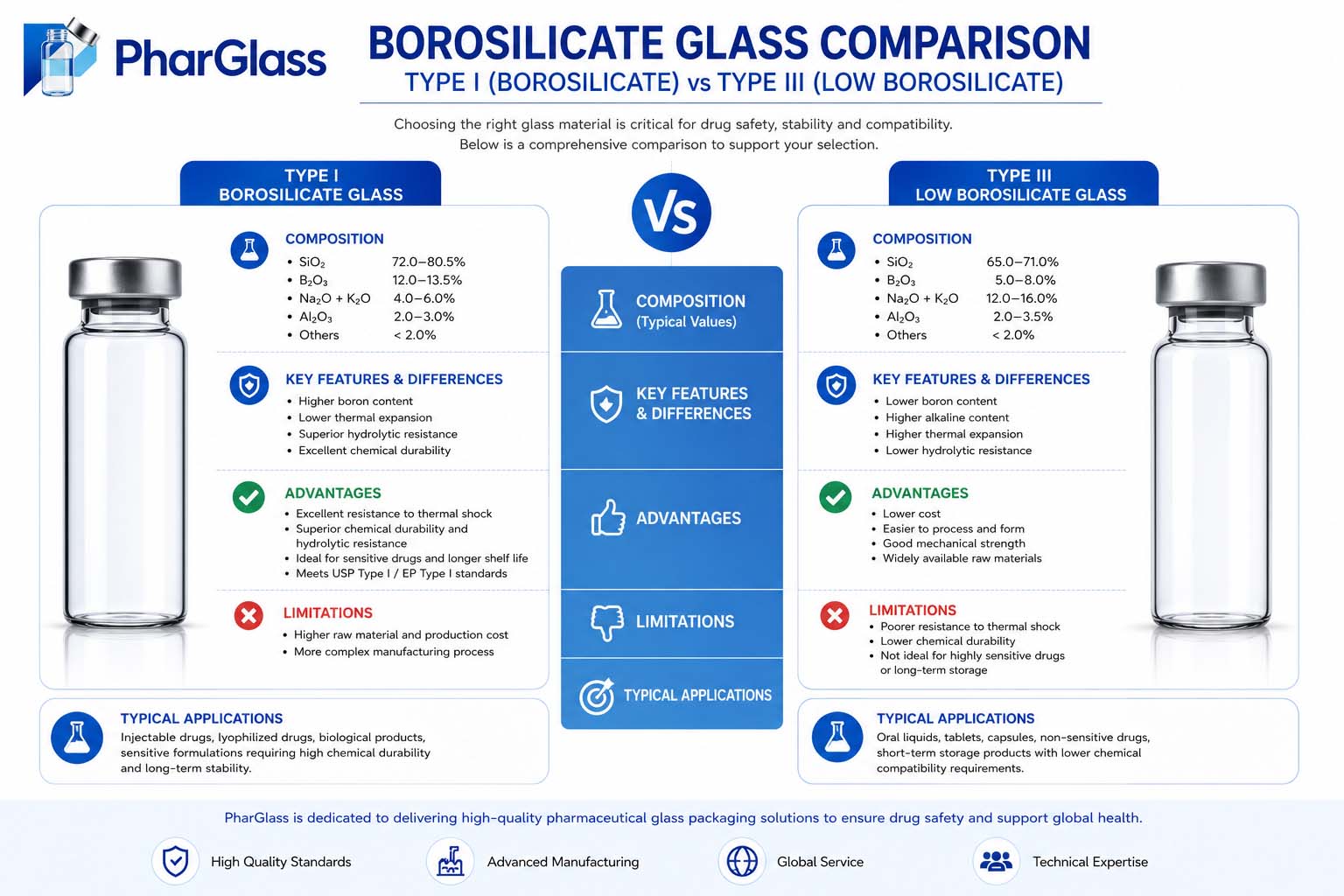
The YBB standards are the authoritative reference for pharmaceutical glass in China. The table below summarises the fundamental compositional differences between mid‑borosilicate (Type I) and low‑borosilicate (Type II) glass.
| Paramètres | Mid‑Borosilicate (Type I, Neutral Glass) | Low‑Borosilicate (Type II) |
|---|---|---|
| B₂O₃ (Boron trioxide) | 8% – 13% | 5% – 8% |
| Alkali metal oxides (Na₂O + K₂O) | Low (<7%) | Higher (8% – 11%) |
| Coefficient de dilatation thermique (CTE) | 3.3 × 10⁻⁶ /°C | 4.5 – 6.5 × 10⁻⁶ /°C |
| Hydrolytic resistance class | Class 1 (highest) | Class 2 |
Key insight: The higher B₂O₃ content in mid‑borosilicate glass creates a stable silica network that immobilises alkali ions. Low‑borosilicate glass has a lower B₂O₃ content and more free alkalis, which compromises long‑term chemical durability, especially under aggressive conditions.
2. Five Key Performance Differences
2.1 Chemical Stability – The Most Critical Distinction
Mid‑borosilicate (Type I)
Due to its low alkali content and dense glass network, Type I glass is chemically inert. It resists attack by acids, alkalis, and water. Under autoclaving (121°C) or prolonged contact with drug solutions, it releases negligible sodium and other alkaline ions. This virtually eliminates the risk of:
- Glass delamination (thin glass flakes detaching into the drug product)
- Visible particles (“white spots”)
- pH drift
- Leachable/extractable contamination
The hydrolytic resistance test per USP <660> and EP 3.2.1 consistently places Type I glass in the highest Class 1 rating, making it suitable for all parenteral applications, including the most sensitive biologics and vaccines.
Low‑borosilicate (Type II)
The higher alkali content makes Type II glass inherently less stable. When storing acidic (pH <5) or alkaline (pH >9) solutions, or after repeated heat sterilisation, Type II glass can release alkali ions into the drug product, causing pH change. In long‑term storage (>2 years), delamination and visible particle formation become real risks.
However, for neutral drug solutions (pH 5–8) that are not subject to extreme temperature cycles, Type II glass performs adequately and complies with YBB and pharmacopoeial requirements for certain applications.
2.2 Thermal Stability (Shock Resistance & Breakage)
Mid‑borosilicate (Type I)
With a CTE of only 3.3 × 10⁻⁶ /°C, Type I glass can withstand rapid temperature differences of 150–200°C without cracking. This makes it the only choice for:
- Lyophilisation (freeze‑drying), where vials go from –40°C freezing to +60°C warming
- Steam sterilisation (121°C) followed by immediate cooling
- Repeated thermal cycling
In industrial lyophilisation lines, the breakage rate of high‑quality Type I vials (e.g., from Zhengzhou PharGlass) is <0.3%.
Low‑borosilicate (Type II)
The higher CTE (4.5–6.5 × 10⁻⁶ /°C) limits the thermal shock resistance to about ≤70°C temperature difference. Therefore, Type II vials are not recommended for lyophilisation or rapid heating/cooling cycles. Their breakage rate in freeze‑drying processes can reach 2.7%, leading to significant production losses.
Advantage: For standard boiling water sterilisation or ambient filling processes, Type II vials perform reliably and do not crack unexpectedly.
2.3 Visual Appearance and Dimensional Precision
Mid‑borosilicate (Type I)
The glass is highly transparent, free of the greenish tint often seen in lower‑grade glasses. The manufacturing process (precision tubing drawing) yields tight tolerances on wall thickness, outer diameter, and neck finish. Excellent batch‑to‑batch consistency ensures reliable sealing with rubber stoppers and reduces reject rates on high‑speed filling lines.
Low‑borosilicate (Type II)
Advantage: Easier to melt and form, which historically made it attractive for domestic Chinese production.
Disadvantage: Most Type II vials exhibit a slight greenish colour. Dimensional variations (wall thickness, roundness, neck concentricity) are larger than those of Type I. Within the same batch, some vials may be thicker on one side – a known cause of stopper leakage or machine jams.
2.4 Production Cost
Mid‑borosilicate (Type I)
Higher raw material costs (boron compounds, high‑purity silica), more energy‑intensive melting, and precision tube‑drawing equipment make Type I vials significantly more expensive. Typical price range: 2.5 to 5 times the cost of low‑borosilicate vials.
Low‑borosilicate (Type II)
Core advantage: Low material cost, abundant domestic production capacity in China, and mature manufacturing technology. For high‑volume, low‑margin products, the cost saving is substantial. Many local Chinese pharmaceutical plants still prefer Type II for conventional injections.
2.5 Mechanical Strength
Type I glass has a more compact internal structure, offering slightly better resistance to impact, dropping, and scratching. Type II glass is more brittle and can chip or shed particles when mechanically stressed. However, for routine automated filling lines with proper handling, both types exhibit acceptable breakage rates – provided the filling line is calibrated for the specific vial dimensions.
3. Pros and Cons Summary
✅ Mid‑Borosilicate (Type I) Glass
Avantages
- Excellent chemical inertness – suitable for strong acids, strong alkalis, sensitive biologics, vaccines, and any product requiring long shelf life (2–5 years) without pH shift or extractables.
- Superior thermal stability – mandatory for freeze‑dried products, prefilled syringes, and cartridge systems.
- Global pharmacopoeia compliance – meets USP, EP, JP, and ChP standards. Preferred or even required (e.g., China’s consistency evaluation for generic injectables) for export drugs and high‑risk parenterals.
- Low delamination risk – confirmed by USP delamination tests.
- High dimensional uniformity – reduces stoppering failures and filling line stoppages.
Inconvénients
- High procurement cost (2.5–5× of Type II)
- Requires specialised manufacturing; limited number of qualified suppliers
- Higher inventory cost
Typical applications
Vaccines, biologics, monoclonal antibodies, gene therapies, lyophilised powders, injectables with extreme pH (<4 or >9), and any drug intended for global markets.
✅ Low‑Borosilicate (Type II) Glass
Avantages
- Significantly lower cost – reduces primary packaging expense by a large margin.
- Adequate for neutral formulations (pH 5–8) under conventional conditions; meets YBB and ChP requirements for many standard injections.
- Abundant domestic Chinese supply – short lead times, flexible minimum order quantities, mature manufacturing base.
Inconvénients
- Unsuitable for strong acids, strong alkalis, or long‑term storage of sensitive molecules.
- Higher risk of delamination, visible particles, and pH drift when exposed to aggressive drugs or thermal stress.
- Not recommended for lyophilisation or extreme temperature changes.
- Slightly lower dimensional consistency.
Typical applications
Conventional water‑based injections (e.g., vitamins, common antibiotics like penicillin, ceftriaxone), oral liquids, syrups, external tinctures, and solid‑dosage bottles (tablets, capsules) where glass is used as a secondary or non‑parenteral container.
4. Selection Guide – A Simple Rule of Thumb
For export drugs, vaccines, lyophilised products, and formulations with extreme pH (acidic or alkaline) → Choose mid‑borosilicate (Type I).
For routine domestic antibiotics in neutral pH, oral liquids, or neutral conventional injections → Low‑borosilicate (Type II) may be acceptable, but always validate.
When in doubt, conduct stability studies per ICH guidelines, including hydrolytic resistance and delamination tests, using your actual drug product.
5. Why Zhengzhou PharGlass Recommends Type I for Most Modern Injectables
Zhengzhou PharGlass specialises in advanced primary pharmaceutical packaging. Our sterile glass vials are manufactured from Type I borosilicate tubing, fully compliant with ISO 8362‑1, YBB, USP <660>, and EP 3.2.1. We offer nests, tubs, and tray configurations pre‑sterilised and ready‑to‑use (RTU), designed to integrate seamlessly into your aseptic filling lines (isolators, RABS, or robotic fill‑finish platforms).
Although low‑borosilicate glass still has a place in low‑risk, neutral‑pH, cost‑sensitive products, the global trend – reinforced by regulatory bodies like FDA, EMA, and China’s NMPA – is shifting toward Type I glass for all injectables, especially those requiring long shelf life or those classified as high‑risk. The 2023 revision of GMP Annex 1 emphasises container closure integrity (CCI) and extractables/leachables risk assessment, where Type I glass offers inherent advantages.
For manufacturers seeking to future‑proof their packaging systems and meet stringent international standards, Zhengzhou PharGlass provides validated Type I glass vials that eliminate the trade‑off between drug safety and line efficiency.
6. Conclusion
The choice between mid‑borosilicate and low‑borosilicate glass vials is not simply about cost – it is about drug stability, patient safety, and regulatory compliance. Type I glass offers superior chemical and thermal performance, making it the preferred material for advanced therapies and export markets. Type II glass remains a cost‑effective option for stable, neutral formulations used in well‑controlled domestic environments.
As a responsible packaging partner, Zhengzhou PharGlass encourages manufacturers to conduct product‑specific compatibility studies. Our technical team is available to provide data, samples, and integration support for both glass types, though our core offering is the higher‑performance Type I range – because the industry’s future is moving towards higher quality, lower risk, and global harmonisation.
This article references the Chinese YBB standards, USP <660>, EP 3.2.1, ISO 8362‑1, and current industry data on thermal shock resistance and delamination. For specific validations, always consult your internal quality unit and regulatory requirements.
 FR
FR  EN
EN  AR
AR  DE
DE  ES
ES  PT
PT  FA
FA  RU
RU