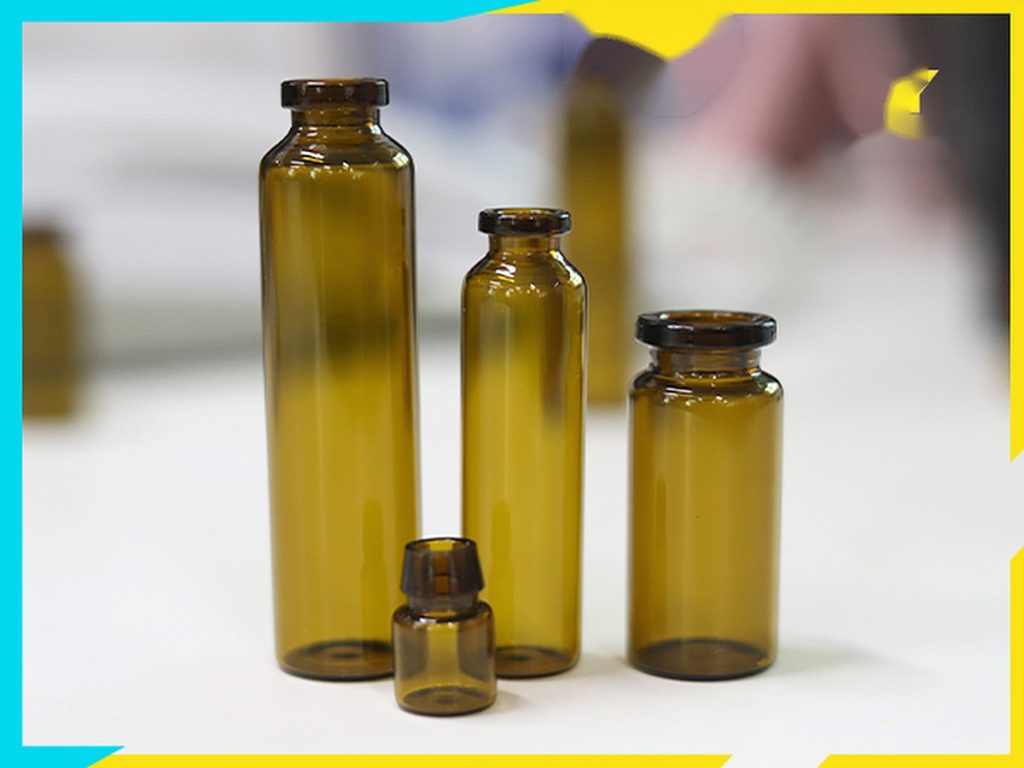
Direct printing on a glass bottle removes the label, but it also introduces a decision that affects durability, appearance and cost. The two common routes are high-temperature ceramic ink and low-temperature ink, and they are not interchangeable.
High-temperature ceramic ink
High-temperature inks contain glass frit and metal oxides. After printing, the bottle passes through a decorating lehr at roughly 560–620 °C, where the ink fuses into the glass surface. The result is a print that is part of the glass rather than a layer on top of it.
The practical benefits are durability and resistance to washing, alcohol and autoclaving. The trade-off is a narrower colour range: the palette is limited by the pigments that survive the firing temperature, and colours tend to look slightly muted compared with paper labels. Firing also adds a process step and a reject risk if the lehr profile is not controlled.
Low-temperature ink
Low-temperature inks are cured at around 150–200 °C, or with UV light. Because the pigment is not fired into the glass, the colour range is wider and brighter, and the process is faster and cheaper for short runs.
The limitation is durability. Low-temperature print is more susceptible to scratching, solvent attack and repeated washing. If the bottle will be sterilised, the ink and the sterilization method must be checked together — some inks discolour or soften under steam or ethylene oxide.
Comparison
| Facteur | High-temperature | Low-temperature |
|---|---|---|
| Firing / curing | 560–620 °C | 150–200 °C or UV |
| Durability | Fused into glass | Surface layer |
| Colour range | Limited, slightly muted | Wide, bright |
| Solvent and wash resistance | Élevé | Moderate |
| Cost at low volume | Plus élevé | Plus bas |
| Autoclave suitability | Generally good | Must be verified |
How to test a printed bottle
Do not judge print quality from a photograph. Ask for samples and run three checks: a tape-pull test on a dried print, a solvent rub with the alcohol or disinfectant used on your line, and a wash cycle that matches your process. For a sterilised product, include the full sterilization cycle and inspect for colour shift, cracking and adhesion loss.
Printing versus labelling
Direct printing suits simple, high-contrast designs — a logo, a dose marking, a graduation. It does not replace a full label where regulatory text, batch information and multilingual content are required. Many pharmaceutical bottles use both: a fired print for branding and a label for the regulated information.
Tell notre équipe commerciale your decoration, sterilization and volume so we can recommend a print route.
 FR
 EN
 AR
 DE
 ES
 PT
 FA
 RU