
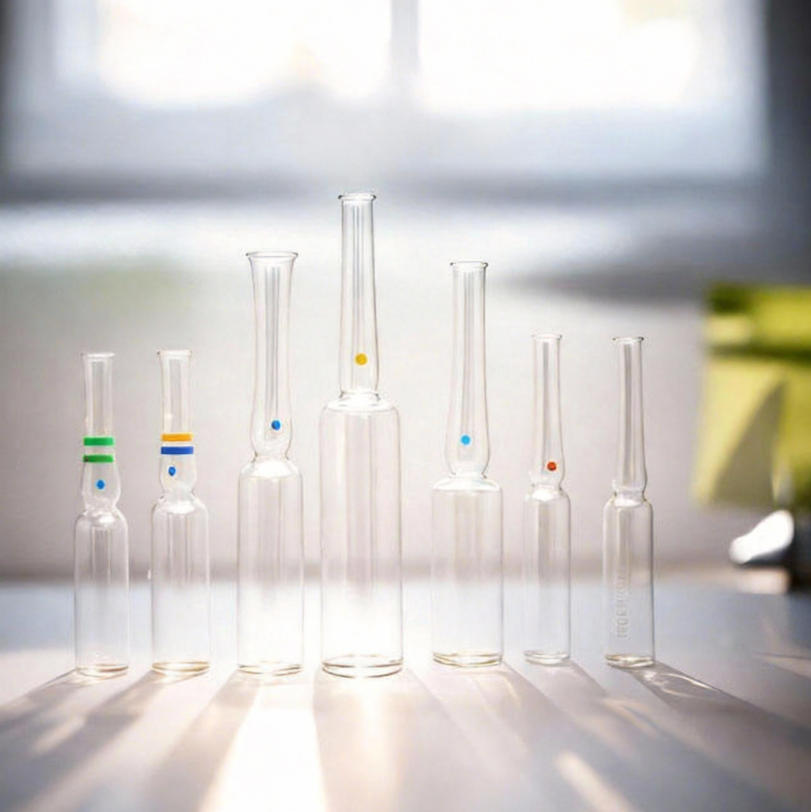
Middle Borosilicate Glass Ampoules for Injectable Pharmaceuticals: Specifications, Standards and Technical Requirements
Introduction
Middle borosilicate glass ampoules are widely used as primary pharmaceutical packaging for injectable preparations where chemical durability, dimensional consistency, mechanical performance, and reliable opening characteristics are critical.
Unlike secondary packaging, an ampoule is in direct contact with the pharmaceutical formulation. The glass therefore forms an important part of the overall container-closure and product protection system. Its material composition, hydrolytic resistance, dimensional accuracy, annealing quality, and predetermined breaking point can all influence packaging performance.
PharGlass manufactures pharmaceutical packaging materials for global pharmaceutical customers, including glass packaging for injectable and sterile products. Our product portfolio is developed around pharmaceutical packaging requirements, quality control, OEM/ODM support, and international customer specifications.
The middle borosilicate glass ampoule shown in the specification sheet is available in nominal capacities from 1 mL to 25 mL, making it suitable for a broad range of small-volume injectable pharmaceutical applications.
1. What Is a Middle Borosilicate Glass Ampoule?
A middle borosilicate glass ampoule is a single-use pharmaceutical container manufactured from middle borosilicate glass tubing and designed for the packaging of injectable pharmaceutical products.
The Chinese pharmaceutical packaging standard YBB 00322005-2-2015 is specifically titled Ampoules Made of Middle Borosilicate Glass Tubing. The standard applies to middle borosilicate glass ampoules with features such as colour break rings and predetermined break points. 国家地质图书馆
Internationally, ISO 9187-1:2010 specifies materials, dimensions, capacities, performance, and packaging requirements for glass ampoules used for injectable pharmaceutical products. The standard covers Forms B, C, and D and applies to ampoules with or without a colour break-ring. ISO confirms that this edition was reviewed and confirmed in 2021 and remains current. ISO
For pharmaceutical manufacturers, this means that selecting an ampoule should involve more than simply matching nominal volume. The glass type, dimensions, hydrolytic resistance, annealing condition, opening performance, and compatibility with the formulation should all be evaluated.
2. Middle Borosilicate Glass: Why Does the Glass Type Matter?
Pharmaceutical glass is not simply ordinary container glass. The chemical composition of the glass affects its interaction with pharmaceutical formulations.
USP General Chapter <660> Containers—Glass explains that pharmaceutical glass may include borosilicate glass and soda-lime-silica glass. Borosilicate glass has high hydrolytic resistance and high thermal-shock resistance associated with its composition and is classified as Type I glass within the USP framework. USP
Hydrolytic resistance is particularly important for pharmaceutical packaging because glass can release alkaline constituents into water or aqueous pharmaceutical preparations under defined test conditions. The resulting interaction must be controlled so that the container does not adversely affect the stability, quality, or safety of the pharmaceutical product.
The suitability of a particular glass container ultimately depends on the formulation and the applicable pharmacopoeial and regulatory requirements. USP specifically notes that Type I glass is suitable for most parenteral and nonparenteral products, while suitability for a particular formulation still needs to be established. USP
Therefore, “borosilicate glass” should not automatically be treated as a substitute for formulation-specific compatibility testing.
3. Specifications of PharGlass Middle Borosilicate Glass Ampoules
According to the technical specification supplied for this product, PharGlass offers the following nominal ampoule capacities:
| Nominal Capacity | Overall Diameter | Overall Height |
|---|---|---|
| 1 mL | 10.00 ± 0.26 mm | 60.00 ± 1.0 mm |
| 2 mL | 11.50 ± 0.26 mm | 70.00 ± 1.0 mm |
| 3 mL | 13.30 ± 0.30 mm | 70.00 ± 1.0 mm |
| 5 mL | 16.00 ± 0.30 mm | 87.00 ± 1.0 mm |
| 10 mL | 18.40 ± 0.35 mm | 102.00 ± 1.0 mm |
| 20 mL | 22.00 ± 0.35 mm | 126.00 ± 1.3 mm |
| 25 mL | 22.00 ± 0.35 mm | 144.00 ± 1.3 mm |
The specification sheet also defines neck dimensions, body diameter, thread/neck-related dimensions, scoring-point dimensions, wall thickness, and other dimensional parameters.
For example, the specification identifies a colour-point diameter of 2.0 ± 0.5 mm and provides dimensional tolerances for the body, neck, and breaking-point area.
These dimensional controls are important because an ampoule must work as part of a complete pharmaceutical filling, inspection, sterilization, handling, and packaging process.
4. Predetermined Breaking Point for Controlled Opening
One of the most distinctive characteristics of a pharmaceutical ampoule is its predetermined opening point.
Depending on the design, the ampoule may use a colour break-ring or a scored breaking point to indicate where the container should be opened. ISO 9187-1 specifically addresses ampoules with and without colour break-rings and includes requirements relating to breaking performance. ISO
A properly designed breaking point needs to achieve a balance between two requirements:
- Sufficient mechanical stability during transportation and handling
- Controlled opening when the ampoule is intentionally broken
If the breaking force is excessively high, operators may experience difficulty opening the ampoule. If the opening area is poorly controlled, the risk of glass fracture or particulate generation may increase.
The Chinese pharmaceutical packaging research literature also identifies breaking force as one of the key technical indicators for glass ampoules. For the middle borosilicate ampoule standard shown in the research comparison, the specified minimum breaking force is 30 N, with maximum values differentiated according to ampoule capacity. 云计算与大数据科学中心
For this reason, breaking-force testing should be treated as an important component of pharmaceutical ampoule quality control rather than simply a dimensional inspection.
5. Hydrolytic Resistance and Chemical Durability
For injectable pharmaceutical packaging, hydrolytic resistance is one of the most important performance characteristics of pharmaceutical glass.
Hydrolytic resistance describes the resistance of the glass surface to the release of soluble alkaline constituents when exposed to water under specified testing conditions.
USP <660> uses hydrolytic resistance as a key basis for the classification of pharmaceutical glass containers. USP
The European Pharmacopoeia framework similarly uses hydrolytic resistance to characterize pharmaceutical glass. Recent revisions to Ph. Eur. general chapter 3.2.1 have further clarified the purposes and interpretation of the relevant glass tests. 欧洲药品与健康护理质量局
For middle borosilicate glass ampoules manufactured according to YBB 00322005-2-2015, the technical requirements include tests associated with glass composition and hydrolytic resistance. Published technical research comparing Chinese pharmaceutical packaging standards reports requirements including boron oxide content, hydrolytic resistance, acid resistance, and alkali resistance for middle borosilicate glass ampoules. 云计算与大数据科学中心
This is especially relevant when ampoules are used with aqueous injectable formulations, biologics, or other pharmaceutical products whose stability may be sensitive to container-material interactions.
6. Annealing Quality and Mechanical Performance
Glass containers are exposed to thermal stresses during forming and manufacturing. If residual stress is not adequately controlled, mechanical performance and resistance to thermal shock can be affected.
Annealing is therefore an important stage in pharmaceutical glass manufacturing.
The international ampoule standard ISO 9187-1 includes annealing quality as one of its performance requirements, together with hydrolytic resistance and breaking force. ISO
For pharmaceutical manufacturers, appropriate annealing helps support:
- Consistent mechanical performance
- Reduced residual stress
- Improved resistance to thermal shock
- More predictable behaviour during downstream processing
- Better dimensional and structural stability
Quality control should therefore evaluate not only the external appearance of the ampoule but also relevant physical and performance characteristics.
7. Ampoule Shape and Dimensional Accuracy
Dimensional accuracy is another important aspect of pharmaceutical ampoule manufacturing.
The specification sheet for this product controls multiple parameters, including:
- Body outside diameter
- Neck outside diameter
- Shoulder/bulb diameter
- Neck-related dimensions
- Overall height
- Height to the neck
- Height to the measuring point
- Height to the breaking point
- Wall thickness
- Breaking-point geometry
The relationship between different diameters is also controlled. The supplied specification includes the requirement:
d₁ > d₃ > d₂ > d₄
Such dimensional relationships help maintain the intended geometry of the ampoule and support consistency during filling, sealing, inspection, packaging, and handling.
ISO 9187-1 likewise establishes dimensional and capacity requirements for ampoules intended for injectable pharmaceutical products. ISO
8. Typical Pharmaceutical Applications
Middle borosilicate glass ampoules can be considered for pharmaceutical products requiring single-use glass primary packaging, subject to formulation compatibility and applicable regulatory requirements.
Typical application areas may include:
Injectable Pharmaceuticals
Small-volume injectable preparations are one of the principal applications for pharmaceutical ampoules.
Sterile Pharmaceutical Products
Glass ampoules can be incorporated into sterile packaging systems where the container material and manufacturing process meet the applicable requirements.
Small-Volume Liquid Preparations
The 1 mL to 25 mL capacity range shown in the PharGlass specification provides options for different fill volumes.
Sensitive Pharmaceutical Formulations
Borosilicate glass can provide useful chemical and thermal properties, but the suitability of the specific glass for a formulation should always be established through appropriate compatibility and stability evaluation.
ISO 9187-1 defines its scope specifically around glass ampoules for injectable pharmaceutical products and addresses their material, dimensions, capacity, performance, packaging, and marking requirements. ISO
9. Middle Borosilicate Glass Ampoules vs. Other Pharmaceutical Glass Containers
It is important to distinguish ampoules from other pharmaceutical glass packaging formats.
| Packaging Type | Typical Characteristic | Opening / Closure |
|---|---|---|
| Glass Ampoule | Single-dose, sealed glass container | Glass neck is broken for access |
| Glass Injection Vial | Reclosable pharmaceutical container | Rubber stopper + aluminum/plastic seal |
| Infusion Bottle | Larger-volume pharmaceutical container | Closure system suitable for infusion |
| Oral Liquid Bottle | Designed for oral pharmaceutical preparations | Screw or other closure |
The choice depends on the drug formulation, required dose volume, route of administration, filling process, sterilization method, closure requirements, and regulatory expectations.
For example, the Chinese standards database separately lists YBB 00292005-2-2015 for middle borosilicate glass tubing injection vials and YBB 00022005-2-2015 for middle borosilicate glass infusion bottles. 国家地质图书馆
This distinction is important for SEO as well as technical accuracy: an ampoule should not be described as an injection vial, even though both can be used for injectable pharmaceuticals.
10. Quality Control Considerations
For pharmaceutical primary packaging, quality control should extend beyond visual inspection.
A comprehensive quality program can include evaluation of:
Dimensional Characteristics
Verification of body diameter, neck dimensions, overall height, wall thickness, and predetermined breaking-point geometry.
Hydrolytic Resistance
Assessment of the glass’s resistance to water interaction according to the applicable standard or pharmacopoeial method.
Mechanical Performance
Evaluation of breaking force and other relevant mechanical properties.
Annealing Quality
Verification that residual stress is controlled within the applicable specification.
Glass Surface Quality
Inspection for visible defects, cracks, bubbles, stones, scratches, and other manufacturing abnormalities.
Chemical Compatibility
Assessment of potential interaction between the glass and the pharmaceutical formulation.
USP <1660> specifically discusses the formation, processing, surface treatments, and evaluation of the inner surface durability of glass containers used for pharmaceutical packaging. USP
11. Why Material–Drug Compatibility Still Matters
A pharmaceutical glass container should never be selected solely because it meets a dimensional standard.
The final packaging system needs to be considered together with the drug formulation.
Relevant considerations may include:
- Formulation pH
- Ionic composition
- Drug concentration
- Storage temperature
- Sterilization conditions
- Contact time
- Light sensitivity
- Potential glass–drug interaction
- Extractables and leachables
- Container surface durability
The European Pharmacopoeia framework emphasizes that the selected glass should not release substances in quantities sufficient to affect pharmaceutical stability or create a toxicological concern. USPBPEP
For this reason, pharmaceutical manufacturers should evaluate the specific formulation–container combination, rather than relying only on the generic designation of the glass.
12. PharGlass Pharmaceutical Glass Ampoule Solutions
PharGlass focuses on pharmaceutical primary packaging materials for injectable, biologic, and sterile pharmaceutical applications.
Our product capabilities include pharmaceutical glass packaging together with rubber stoppers and aluminum-plastic caps, allowing customers to source complementary components for their pharmaceutical packaging systems.
For middle borosilicate glass ampoules, we can support requirements involving:
- Different nominal capacities
- Dimensional specifications
- Colour break-ring or predetermined breaking-point configurations
- Pharmaceutical packaging applications
- OEM/ODM requirements
- Customer-specific technical specifications
- Quality documentation and inspection requirements
For projects requiring compliance with a particular pharmacopoeia or customer specification, the applicable requirements should be confirmed during technical evaluation and quotation.
Frequently Asked Questions
What are middle borosilicate glass ampoules used for?
Middle borosilicate glass ampoules are pharmaceutical primary containers designed mainly for injectable pharmaceutical products. Their use should be based on the formulation, packaging process, and applicable regulatory requirements.
What is YBB 00322005-2-2015?
YBB 00322005-2-2015 is the Chinese pharmaceutical packaging industry standard titled Ampoules Made of Middle Borosilicate Glass Tubing. The standard covers middle borosilicate glass ampoules, including colour-ring and point-scored easy-break configurations. 国家地质图书馆
What is the difference between an ampoule and a vial?
An ampoule is normally a sealed, single-use glass container that is opened by breaking the neck. A vial generally uses a stopper and sealing system and can be designed to allow withdrawal of the contents through the stopper.
What capacities are available?
The PharGlass specification shown for this product covers nominal capacities of 1 mL, 2 mL, 3 mL, 5 mL, 10 mL, 20 mL, and 25 mL.
Is middle borosilicate glass suitable for injectable drugs?
It can be used for pharmaceutical packaging applications where its material properties and the finished container meet the applicable requirements. However, the suitability of a particular container for a specific drug formulation should be confirmed through appropriate compatibility and stability evaluation.
Does ISO 9187 apply to pharmaceutical ampoules?
Yes. ISO 9187-1:2010 specifically addresses ampoules for injectable pharmaceutical products and covers materials, dimensions, capacities, performance, packaging, and related requirements. ISO states that the 2010 edition remains current following its 2021 review. ISO
Conclusion
Middle borosilicate glass ampoules are precision pharmaceutical primary packaging components rather than simple glass containers. Their performance depends on the interaction of glass composition, dimensional accuracy, hydrolytic resistance, annealing quality, mechanical strength, breaking-point design, and formulation compatibility.
The PharGlass middle borosilicate glass ampoule range covers 1–25 mL nominal capacities and is designed around the dimensional requirements shown in the YBB 00322005-2-2015 specification.
For international pharmaceutical customers, standards such as YBB 00322005-2-2015 and ISO 9187-1 provide useful reference points for evaluating ampoule dimensions and performance, while pharmacopoeial requirements such as USP <660> provide additional considerations for pharmaceutical glass and hydrolytic resistance. 国家地质图书馆
The final selection of an ampoule should always be based on the pharmaceutical formulation, filling and sterilization process, intended storage conditions, applicable regulatory requirements, and validated container-product compatibility.
 EN
 FR
 AR
 DE
 ES
 PT
 FA
 RU