Why Small Pharma Buyers Keep Getting Burned on Glass Ampoules
For small and mid-sized pharma companies in the US and EU — biotech startups, generic injectable makers, CDMOs, orphan-drug sponsors — the ampoule is rarely a “cheap commodity item.” It becomes a qualification headache when the glass is not really Type I, the COA does not match the batch, or the filler line starts rejecting units.
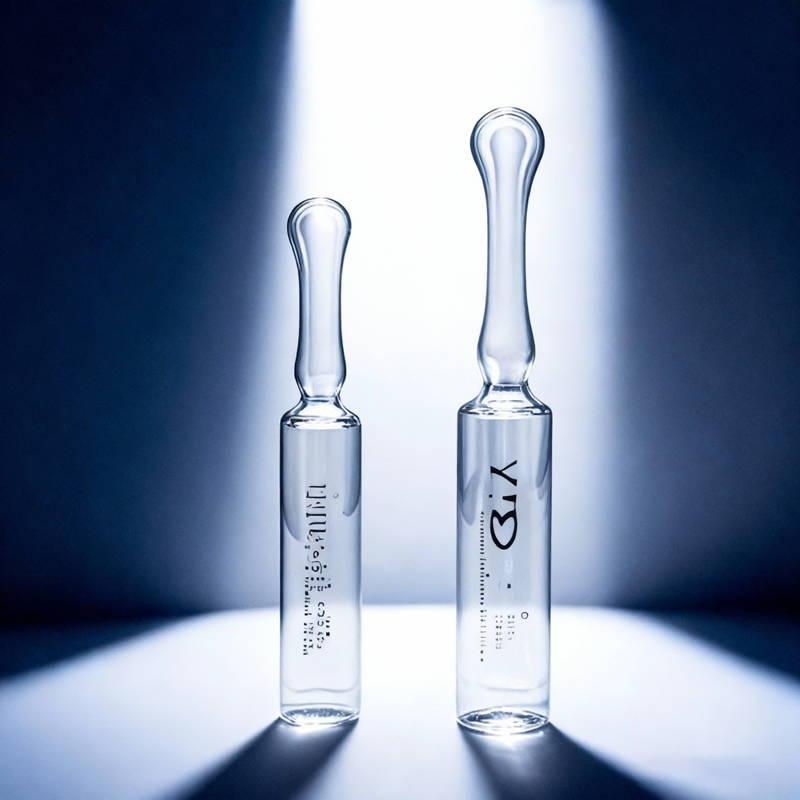
At PharGlass, we manufacture neutral borosilicate glass ampoules (1–25 ml) under YBB00322005-2-2015, aligned with USP <660> and EP 3.2.1. This article breaks down the real pain points Western small-pharma buyers face — and what a qualification-ready ampoule actually looks like.
1. “Type I” on the Website ≠ Type I in the Lab
Many distributors label ampoules as “borosilicate” while supplying low-boro or soda-lime glass. Regulators do not care about marketing words; they care about tested hydrolytic resistance.
Under USP <660>, Type I glass is borosilicate glass with high hydrolytic resistance due to its own chemical composition.
YBB00322005-2-2015 requires neutral borosilicate ampoules to show:
- Boron oxide (B₂O₃) content ≥ 8%
- Linear thermal expansion coefficient 3.5–6.1 × 10⁻⁶ K⁻¹ (20–300°C)
- 121°C grain hydrolytic resistance: Class 1
- Internal surface hydrolytic resistance: HC1
If the COA does not list these values per batch, the ampoule is not audit-ready.
2. Extractables, pH Drift & Biologic Stability
Injectables are a high-interaction route. Poor glass releases alkali ions, shifts pH, and increases leachable load — especially for biologics, peptides, and alkaline formulations.
Neutral borosilicate reduces this because:
- Very low alkali extraction vs soda-lime glass
- Stable under autoclave (121°C) and freeze-dry cycles
- Flame-sealed → no rubber stopper → no elastomer extractables
That is why USP <660> recommends Type I for parenterals, and EP 3.2.1 treats neutral borosilicate as the default for sensitive preparations.
Important: the ampoule supplier can provide glass chemistry, hydrolytic class, and E&L-support documents — but the full extractables/leachables study must still be run by the drug sponsor with the actual formulation.
3. Breakage on Fill-Finish Lines
Small CDMOs running semi-auto or high-speed lines do not tolerate neck variation.
Common failure modes:
- Micro-cracks from poor annealing
- Neck OD out of tolerance → unstable flame seal
- Uneven score line → splinter particles
- Break force too high → nurse injury; too low → line losses
YBB00322005-2-2015 controls this with:
- Wall thickness ≥ 0.20 mm
- Run-out / vertical deviation limits
- Internal stress ≤ 40 nm/mm after annealing
- Easy-break options: OPC dot-nick, color break ring, score ring
ISO 9187-1 defines break-force expectations for OPC ampoules; typical ranges are ~24–65N depending on size. PharGlass sets per-size break-force windows and runs inline camera inspection so the ampoule opens cleanly without glass particles.
4. MOQ & Lead Time Kill Clinical Batches
Large European glass mills often quote:
- MOQ 250k–500k pcs
- 14–18 weeks lead time
That does not work for:
- Phase I/II clinical lots
- Orphan-drug campaigns
- Stability batches (ICH conditions)
- Formula iteration
Small pharma needs 20k–100k viable, repeatable dimensions, export packing, and fast reorder. PharGlass supports flexible MOQ OEM/ODM ampoule supply without forcing buyers into commercial-scale volume too early.
5. “Certificate PDF” Is Not Compliance
Western QA teams lose weeks when files do not match:
- COA batch number ≠ shipped batch
- GMP certificate scope ≠ ampoule line
- No YBB clause reference
- No USP/EP cross-map
- No change-control statement
A qualification-ready ampoule package should include:
- Batch-linked COA
- YBB00322005-2-2015 conformance statement
- USP <660> / EP 3.2.1 alignment note
- Dimensional report (body OD, neck OD, height, run-out)
- Break-force test summary
- GMP manufacturing declaration
- Change-notification policy
This is what actually passes supplier qualification, not a generic “glass certificate.”
6. PharGlass Neutral Borosilicate Ampoule Specs
- Glass: Type I neutral borosilicate tubing
- Sizes: 1 / 2 / 3 / 5 / 10 / 20 / 25 ml
- Forms: straight stem (Form B), funnel tip (Form C), closed (Form D)
- Break systems: OPC dot-nick, color break ring, score ring
- Color: clear or amber
- Standard: YBB00322005-2-2015
- Aligned: USP <660>, EP 3.2.1, ISO 9187-1
- Use: injectables, biologics, vaccines, lyophilized powder
7. RFQ Checklist for Small Pharma Buyers
Before you request a quote, ask the supplier:
- Is B₂O₃ ≥ 8% on the COA?
- Class 1 grain hydrolytic + HC1 internal surface?
- Linear expansion coefficient declared?
- Annealing stress reported?
- Neck OD and run-out tolerances per YBB?
- Break-force range by size?
- MOQ under 100k possible?
- USP <660> + EP 3.2.1 mapping provided?
- Lot-linked COA, not generic?
- Written change-control on reformulation?
If the answer is “we can send later,” that is your delay risk.
8. Conclusion
Small pharma does not need the cheapest ampoule. It needs:
- Proven Type I chemistry
- Dimensions that fit the filler
- Low breakage + clean opening
- E&L-friendly glass system
- Small-batch supply
- Audit-ready docs at PO time
Neutral borosilicate ampoules are the baseline for injectables — not a premium upgrade.
PharGlass supplies YBB-manufactured, USP/EP-aligned ampoules with Western-format technical files, low MOQ OEM support, and batch-level traceability for global pharmaceutical clients.
Contact PharGlass for: sample lot → COA package → dimensional drawing → fill-line compatibility check.

 EN
 FR
 AR
 DE
 ES
 PT
 FA
 RU