1. Introduction: The Evolution of Sterile Pharmaceutical Packaging
The pharmaceutical packaging industry is undergoing a fundamental transformation driven by the increasing demand for biologics, vaccines, and injectable drugs, alongside stringent regulatory requirements that demand uncompromising sterility assurance. Within this landscape, sterile glass bottles—particularly those supplied in ready-to-use (RTU) formats—have emerged as a cornerstone of modern aseptic fill-finish operations. These pre-sterilized, pre-washed, and depyrogenated containers enable pharmaceutical manufacturers to eliminate in-house washing and sterilization processes, significantly reducing contamination risks while accelerating time-to-market.
The global pharmaceutical glass packaging market is valued at approximately USD 23 billion, with growth driven primarily by the demand for safe and sterile packaging solutions for injectable medications and vaccines. The increasing prevalence of chronic diseases and the expansion of biologics and biosimilars have further propelled this demand.More specifically, the global ready-to-use pharmaceutical glass primary packaging market was valued at US$ 5,011 million in 2024 and is projected to reach US$ 7,528 million by 2031, growing at a compound annual growth rate (CAGR) of 6.3%.Within this market, sterile glass vials represent a significant segment, valued at USD 2.32 billion in 2025 and projected to reach USD 3.85 billion by 2032, reflecting a robust CAGR of 7.50%.
This article provides a comprehensive technical overview of sterile glass bottles in ready-to-use formats, covering their definition, key characteristics, manufacturing processes, sterilization technologies, regulatory compliance framework, market drivers, and applications across the pharmaceutical and biotechnology industries.
2. Defining Sterile Glass Bottles: What Are They?
A sterile glass bottle—in the context of pharmaceutical packaging—refers to a glass container that has undergone a rigorous sterilization process (such as dry heat, ethylene oxide, or gamma irradiation) and is supplied in sealed, sterile packaging that maintains its aseptic state until the point of use. Ready-to-use (RTU) pharmaceutical glass primary packaging is defined as pre-sterilized glass containers—including vials, bottles, syringes, ampoules, and cartridges—that are delivered to pharmaceutical manufacturers in a sterile, ready-for-filling condition.
The fundamental distinction between RTU sterile glass bottles and conventional bulk containers lies in the value chain allocation. In traditional pharmaceutical manufacturing, drug companies receive unsterilized glass containers that must undergo washing, drying, depyrogenation, and sterilization in-house—processes that require substantial capital investment in equipment, cleanroom space, water-for-injection (WFI) systems, and qualified personnel. By contrast, RTU sterile glass bottles arrive pre-processed, eliminating these upstream steps entirely. As industry experts note, while washing, depyrogenizing, and sterilizing glass primary packaging are non-core activities for pharmaceutical companies focused on drug development, RTU systems ensure sterility without significant investment or operational demands.
Key Characteristics of Sterile Glass Bottles (RTU Format)
| Recurso | Descrição |
|---|---|
| Sterility Assurance | Sterilized using validated methods (dry heat, EtO, gamma irradiation) to achieve a sterility assurance level (SAL) of 10⁻⁶ |
| Depirogenização | Endotoxins and pyrogens are removed through validated depyrogenation processes, typically dry heat at ≥250°C |
| Pre-washed Condition | Containers are washed with WFI-grade water before sterilization, eliminating particulate contamination |
| Sealed Secondary Packaging | Double-layer Tyvek or medical-grade film packaging maintains sterility throughout transport and storage |
| Immediate Usability | No washing, sterilization, or drying required prior to aseptic filling |
| ISO/GMP Compliance | Manufactured under cGMP conditions and certified to ISO 13485, ISO 15378, and relevant pharmacopoeial standards |
3. Manufacturing Process: From Glass Formation to Sterile Delivery
The production of sterile glass bottles in an RTU configuration involves a multi-stage process that must be executed under strictly controlled conditions to ensure product quality and sterility assurance.
3.1 Glass Container Manufacturing
The base glass containers are manufactured using either tubular glass ou molded glass technologies. Borosilicate glass, particularly Type I borosilicate, is the preferred material for pharmaceutical applications due to its superior chemical inertness, thermal shock resistance, and excellent barrier properties. This material has gained even greater prominence following the COVID-19 pandemic, as mRNA vaccines—which require ultra-cold storage—have cemented the dominance of Type I borosilicate glass due to its superior chemical inertness and thermal shock resistance.
3.2 Washing and Depyrogenation
After manufacturing, the glass bottles undergo a validated washing process using Water for Injection (WFI) to remove any particulate matter. This is followed by depyrogenation, which is the process of removing pyrogens (primarily bacterial endotoxins). Dry heat depyrogenation is the traditional and most widely accepted method for glass components, where containers are heated to temperatures typically exceeding 250°C for a predetermined duration to achieve endotoxin reduction of at least 3 log units.
3.3 Sterilization Methods
RTU sterile glass bottles are sterilized using one of several validated methods, depending on the container material, closure configuration, and customer requirements:
| Método de esterilização | Aplicação típica | Key Considerations |
|---|---|---|
| Calor seco | Glass vials, bottles | Suitable for glass only; achieves depyrogenation and sterilization simultaneously; requires significant energy |
| Ethylene Oxide (EtO) | Glass with polymer components | Effective at lower temperatures; requires aeration to remove residues; approximately 45% of RTU containers are sterilized using EtO |
| Gamma Irradiation | Glass with compatible closures | Cold process; no residue concerns; requires dose validation to ensure material compatibility |
3.4 Packaging Configurations
Once sterilized, RTU sterile glass bottles are packaged in formats designed to maintain sterility and facilitate automated filling operations. The two predominant configurations are:
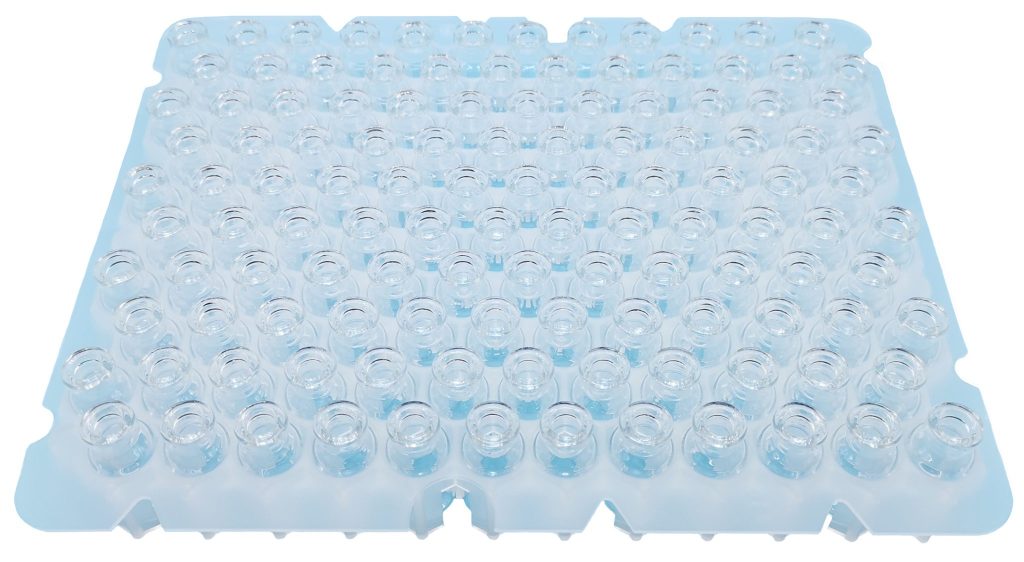
- Nest & Tub: Vials are securely held in a plastic nest (typically holding 100 vials per nest) within a rigid tub, with glass-to-glass contact eliminated to prevent breakage and particulate generation. This configuration is standardized under ISO 11040-7 and ISO 21882 standards.
- Tray (Partitioned): Vials are arranged in partitioned trays for bulk fill-and-finish operations, offering greater flexibility for large-scale production lines.
4. Applications of Sterile Glass Bottles
Sterile glass bottles in RTU format are essential across multiple sectors of the healthcare and life sciences industries.
4.1 Pharmaceutical and Biotechnology Applications
| Aplicativo | Descrição |
|---|---|
| Injectable Drugs | Small-molecule parenterals requiring sterile packaging for intravenous, intramuscular, or subcutaneous administration |
| Vacinas | Including mRNA vaccines (e.g., COVID-19 vaccines) that demand ultra-cold storage compatibility and chemical inertness; vaccine-specific glass bottles are made from borosilicate glass resistant to acid/alkali erosion and thermal shock |
| Biologics and Biosimilars | Sensitive protein therapeutics requiring minimal extractables and leachables |
| Ophthalmic Preparations | Eye drops and other sterile ophthalmic solutions |
| Oral Liquids | Sterile oral solutions, syrups, and suspensions |
| Lyophilized Products | Freeze-dried drugs requiring vials that can withstand the lyophilization process |
4.2 Laboratory and Research Applications
In laboratory settings, sterile glass bottles are used for storing sterile reagents, cell culture media, PCR reagents, and standard solutions.Their pre-sterilized nature eliminates the need for autoclaving or dry-heat sterilization in the laboratory, saving valuable time and reducing the risk of contamination during experimental workflows.
4.3 Cosmetics and Personal Care
The cosmetics industry is increasingly adopting sterile glass packaging for high-end products requiring aseptic filling, including injectable aesthetic products, sterile serums, and premium formulations where sterility directly correlates with product safety and shelf-life.
5. Key Advantages: Why Transition to RTU Sterile Glass Bottles?
The shift from conventional bulk glass containers to RTU sterile glass bottles is driven by compelling technical, operational, and economic advantages.
5.1 Contamination Risk Reduction
Contamination is arguably the greatest risk in aseptic fill-finish operations. By eliminating in-house washing, drying, depyrogenation, and sterilization—each step presenting opportunities for microbial or particulate contamination—RTU systems significantly reduce the contamination risk profile.Furthermore, the nest-and-tub configuration prevents glass-to-glass contact, reducing particle generation and container breakage that can lead to costly rejects.
5.2 Capital Expenditure (CAPEX) Savings
Traditional bulk filling lines require substantial investment in washing equipment, depyrogenation tunnels, WFI systems, and expanded cleanroom footprints. By outsourcing these processes to specialized packaging suppliers, pharmaceutical companies can avoid these capital expenditures entirely. As noted in industry analysis, RTU packaging eliminates significant operational constraints for pharmaceutical companies while delivering CAPEX savings.
5.3 Operational Expenditure (OPEX) Reduction
Beyond initial investment, RTU systems deliver ongoing operational savings: elimination of washing and sterilization energy costs; reduced water-for-injection consumption; lower cleanroom operational costs due to smaller required footprints; fewer personnel required for line operation; reduced maintenance costs for washing/sterilization equipment; lower cost of non-quality from reduced breakage and rejects. Industry studies have confirmed that switching to sterile RTU glass vials can offer savings across the entire product lifecycle while improving patient safety through superior quality.
5.4 Reduced Time-to-Market
In an increasingly competitive pharmaceutical marketplace, speed matters. RTU sterile glass bottles eliminate the need for validation of in-house washing and sterilization processes, as well as lengthy changeover times between different container formats. This streamlining enables pharmaceutical companies to bring products to market faster, a critical advantage for first-to-market biologics and generics.
5.5 Regulatory Compliance Support
New regulations, including the updated EU GMP Annex 1 (effective August 25, 2023), require pharmaceutical manufacturers to implement comprehensive Contamination Control Strategies (CCS) and demonstrate Quality Risk Management principles.RTU containers offer a time-efficient and cost-effective solution for compliance, as the packaging supplier assumes responsibility for the validation and maintenance of sterilization processes.
6. Market Drivers and Growth Trends
Several interconnected trends are driving the adoption of sterile glass bottles in RTU formats:
- Biologics and Injectable Expansion: The rising prevalence of biologics, biosimilars, and injectable drugs—which require sterile primary packaging—continues to expand the addressable market. Global pharmaceutical glass packaging growth is fueled by innovations and sustainable practices, with vials and ampoules particularly dominant due to their widespread use in storing injectable drugs and vaccines.
- mRNA Vaccine Legacy: The COVID-19 pandemic accelerated the development and deployment of mRNA vaccines requiring ultra-cold storage, reinforcing the dominance of Type I borosilicate glass and increasing demand for pre-sterilized packaging solutions that minimize handling.
- Personalized Medicine: The shift toward smaller-batch, personalized therapies requires flexible filling lines capable of switching between different container formats with minimal downtime—a capability that RTU systems excel at providing.
- Asia-Pacific Growth: The Asia-Pacific region is emerging as a significant growth driver for pharmaceutical glass packaging, with increased pharmaceutical production and investments in manufacturing automation.The ready-to-use pharmaceutical glass primary packaging market is expected to grow with a CAGR of 6.3% from 2025 to 2031, with Asia-Pacific expected to witness the highest growth.
- Emerging Trends: Industry reports highlight several emerging trends reshaping the RTU packaging landscape: growing popularity of pre-filled syringes; emphasis on high-quality borosilicate glass; advancements in coating technologies (e.g., silicon-based coatings to reduce drug-container interaction); integration of digitalization and traceability (QR codes, RFID tags); and a focus on sustainable packaging solutions.
7. Quality Standards and Regulatory Compliance
Sterile glass bottles for pharmaceutical applications must comply with an extensive framework of international standards and regulatory requirements. Key standards include:
| Padrão | Scope |
|---|---|
| ISO 13485 | Quality management systems for medical devices |
| ISO 15378 | Primary packaging materials for medicinal products—specific requirements for GMP application |
| ISO 11040-7 | Pre-filled syringes—Part 7: Packaging systems for components ready for filling |
| ISO 11135 | Sterilization of health care products—Ethylene oxide |
| USP | Containers—Glass |
| EP 3.2.1 | Glass containers for pharmaceutical use (European Pharmacopoeia) |
| 21 CFR Part 211 (FDA) | Current good manufacturing practice for finished pharmaceuticals |
| Anexo 1 das BPF da UE | Manufacture of sterile medicinal products |
The FDA requires that all pharmaceutical glass packaging meet specific quality standards for identity, strength, quality, and purity to ensure the safety and efficacy of medications, mandating rigorous testing for chemical resistance, durability, and sterility.
For RTU products, the packaging supplier must maintain validated sterilization processes, validated depyrogenation processes, validated packaging integrity testing, environmental monitoring of cleanroom manufacturing areas, and complete traceability from glass formation to final sterilization.
8. Cost-Benefit Analysis: RTU vs. Traditional Bulk Containers
A comprehensive total cost of ownership (TCO) analysis is essential when evaluating the transition to RTU sterile glass bottles. Key cost factors to consider include:
| Cost Factor | Traditional Bulk | RTU (Pre-sterilized) |
|---|---|---|
| Washing equipment | ✓ Required | ✗ Eliminated |
| Depyrogenation tunnel | ✓ Required | ✗ Eliminated |
| WFI system | ✓ Required | ✗ Eliminated |
| Expanded cleanroom | ✓ Required | Reduced footprint |
| In-house sterilization validation | ✓ Required | Outsourced to supplier |
| Glass-to-glass contact risk | Higher risk | Eliminated (nest & tub) |
| Changeover time | Longer | Reduced (standardized formats) |
| Energy consumption | Higher | Lower |
| Personnel costs | Higher | Lower |
As documented in pharmaceutical manufacturing literature, advantages of pre-sterilized containers include lower investment costs and smaller-footprint equipment for filling and closing, with fewer processing steps and less handling helping to reduce damage.
9. Conclusion: The Future of Sterile Glass Packaging
The pharmaceutical packaging industry is at an inflection point. As drug formulations become more complex, regulatory requirements more stringent, and patient safety expectations higher than ever, the adoption of sterile glass bottles in ready-to-use formats is no longer a competitive differentiator—it is becoming an industry standard.
For pharmaceutical and biotechnology companies, RTU sterile glass bottles offer a compelling value proposition: reduced contamination risk, lower total cost of ownership, faster time-to-market, and enhanced regulatory compliance support. For contract manufacturing organizations (CMOs) and emerging biotech firms with limited capital resources, RTU systems provide access to world-class sterile packaging without the burden of in-house infrastructure investment.
As the global ready-to-use pharmaceutical glass primary packaging market continues its trajectory toward US$ 7.5 billion by 2031 and beyond, one conclusion is clear: sterile glass bottles are the future of aseptic pharmaceutical packaging—delivering the sterility, reliability, and performance that the healthcare industry demands, while enabling manufacturers to focus on what matters most: developing life-saving medicines.
Zhengzhou PharGlass is a professional supplier of pharmaceutical packaging materials, offering high-quality sterile glass bottles (ready-to-use format), pharmaceutical rubber stoppers, and aluminum plastic caps for the medical and pharmaceutical industries. With OEM/ODM capabilities and global shipping, PharGlass supports pharmaceutical manufacturers worldwide in their transition to safer, more efficient primary packaging solutions.

 PT
PT  EN
EN  FR
FR  AR
AR  DE
DE  ES
ES  FA
FA  RU
RU