
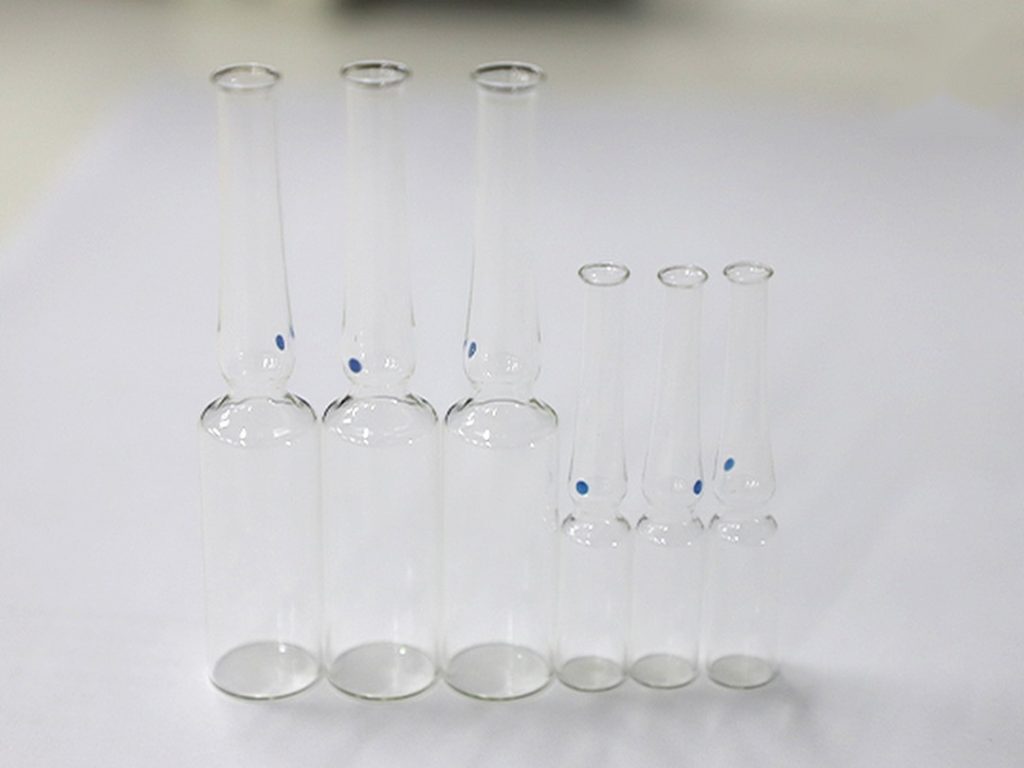
Every glass ampoule begins as a straight length of pharmaceutical tubing and ends as a sealed, single-dose container that has to open cleanly and release no particles into the drug. The manufacturing process between those two points is simple in principle and demanding in practice, because each step changes the mechanical strength of the glass and the accuracy of the opening point.
This guide follows the process in the order it happens on the production floor, and explains which parameters buyers should ask about when qualifying an ampoule supplier.
The ampoule manufacturing process at a glance
- Pharmaceutical glass tubing selection
- Cutting the tubing to length
- Rotary forming of body, neck and tip
- Annealing to relieve stress
- Colour break ring printing and firing
- Inspection, testing and packing
1. Glass tubing selection
Ampoules are drawn from glass tubing, so the tubing is the first quality decision. Type I borosilicate tubing is the standard for injectables because of its high hydrolytic resistance; low borosilicate and soda-lime tubing are used for less demanding products. The glass type must be declared against USP <660> and EP 3.2.1, and the tubing certificate should follow the finished ampoules through the lot records.
Outside diameter, wall thickness and concentricity all affect forming. Tubing that is out of tolerance produces ampoules with uneven wall sections, which show up later as breakage during filling or as cracks after sealing. Buyers who audit a supplier should ask how incoming tubing is sampled, not only how finished ampoules are inspected. Our pharmaceutical glass tubing is supplied with dimensional and hydrolytic resistance data for this reason.
2. Cutting the tubing to length
The tubing is cut to a fixed length that determines the nominal capacity of the ampoule. Diamond cutting wheels or laser cutting are used, and the cut end must be free of burrs and micro-cracks. Length tolerance is usually tighter than the general drawing tolerance because the cut length controls the volume above the constriction. Cut pieces are normally checked by weight and length at the start of each shift.
3. Rotary forming
The cut tube is rotated while gas burners soften the glass. The bottom is closed first, then the neck is pulled down to form the constriction and the tip. Wall thickness in the neck is the critical dimension: too thin and the ampoule breaks away from the opening point; too thick and the user cannot snap it cleanly.
At this stage the seat for the colour break ring is also formed. Forming is monitored by dimensional checks on the neck diameter, constriction diameter, tip length and overall height, supported by break tests on samples from each cavity.
4. Annealing
Forming leaves residual stress in the glass. Ampoules pass through a lehr where the temperature is raised above the strain point and then reduced on a controlled curve. Poor annealing does not always show up visually at first; it appears as random breakage during washing, filling or transport, and as a higher rate of splinters when the ampoule is opened. Annealing records and break-force data are therefore part of the quality file, not just the cosmetic inspection result.
5. Colour break ring and printing
A colour break ring is a fired ceramic ink ring applied at the constriction. It marks the opening point, helps the user apply force in the right place and reduces the risk of irregular breakage. The ring is printed before the final firing step so that it bonds to the glass rather than sitting on the surface.
Not every market uses colour break rings. Cut ring and one-point cut (OPC) ampoules rely on a scored neck instead, and remain common on older filling lines. The choice affects the filling line, the user instruction and the break-force specification, which is why it is normally fixed at quotation rather than changed later. Our guide to ampoule breakability testing covers the measurement methods in detail.
6. Inspection and testing
Finished ampoules pass through cosmetic and dimensional inspection before packing. The checks that matter most to a pharmaceutical buyer are:
- Cosmetic defects: cracks, bubbles, stones, scratches and neck deformation.
- Dimensional checks: height, body diameter, neck and constriction diameter, tip length.
- Break force and break behaviour on samples from each production lot.
- Hydrolytic resistance at the surface, tested to USP <660> or EP 3.2.1.
- Visual inspection for loose glass particles after breaking.
Automated camera inspection is increasingly used for cosmetic defects, but it does not replace break testing. The practical question for buyers is not whether a supplier has a camera, but which defect classes the camera rejects and how that rejection limit was validated. Our article on glass ampoule defect inspection lists the defect classes and the sampling approach.
7. Washing and depyrogenation
Ampoules are usually washed and depyrogenated at the filling site, immediately before filling, rather than at the glass factory. Suppliers who offer ready-to-use formats perform washing and depyrogenation in a controlled line and pack the ampoules in nests and tubs for direct entry into the filler. Whether this is worth it depends on the filling line and the product; the cleaning and depyrogenation steps are summarised in our ampoule hygiene guide.
8. Packing and filling line compatibility
Packing is part of the manufacturing process because it determines how the ampoules arrive at the filling line. Shrink-wrapped trays suit manual and semi-automatic lines; nests and tubs suit automated lines that require a fixed pattern. The packing format must match the infeed of the washing machine, so it is normally agreed together with the dimensional drawing. Common sealing and leakage issues are covered in our article on ampoule sealing performance.
Process control points and why they matter
| Step | Key control | Why it matters |
|---|---|---|
| Tubing | Glass type, OD, wall, concentricity | Determines forming stability and chemical resistance |
| Cutting | Length, burr-free ends | Controls nominal capacity and avoids micro-cracks |
| در حال شکلگیری | Neck and constriction dimensions | Controls break behaviour and opening force |
| Annealing | Temperature curve and residual stress | Prevents random breakage and splintering |
| چاپ | Ring position and ink firing | Marks the opening point and bonds to the glass |
| Inspection | Defect classes, break force, hydrolytic resistance | Confirms the lot is fit for filling |
What to verify when qualifying an ampoule supplier
- Tubing certificate with glass type and hydrolytic resistance data.
- Dimensional drawing agreed before the first production run.
- Break-force data, not only a cosmetic sample.
- Certificate of analysis per lot, linked to the tubing lot.
- A packing format that matches your washing and filling line.
- A written change-control process for tubing source or forming tools.
PharGlass produces Type I borosilicate ampoules from 1 ml to 20 ml in colour break ring, cut ring and closed formats, with forming, annealing, inspection and packing handled in a controlled cleanroom environment. If you are qualifying a new format or converting an existing line, send the drawing, annual volume and machine model and we will confirm what is practical before quotation.
View pharmaceutical glass ampoules 1 ml to 20 ml یا contact us for a quotation.
سوالات متداول
What glass type is used for pharmaceutical ampoules?
Injectable ampoules are normally made from Type I borosilicate glass tubing, tested to USP <660> and EP 3.2.1. Low borosilicate and soda-lime glass are used for less sensitive products where the regulatory filing allows it.
How are glass ampoules sealed?
After filling, the tip is melted with a gas flame and drawn closed. The seal must be complete but thin enough to open at the break ring, so sealing parameters are set together with the ampoule dimensions on the filling line.
What is the difference between a colour break ring and a cut ring ampoule?
A colour break ring marks the opening point with a fired ceramic ring and is the usual choice for hospital and clinical use. A cut ring or OPC ampoule uses a scored neck instead and is common on older filling lines.
آیا میتوان آمپولها را در لانهها و وانها عرضه کرد؟
Yes. Nests and tubs are available for automated filling lines, and shrink-wrapped trays for manual and semi-automatic lines. The format is confirmed against the infeed of your washing machine.
What is the minimum order quantity for glass ampoules?
MOQ depends on capacity, format and packing. For standard 2 ml and 5 ml colour break ring ampoules, small trial orders are possible; larger annual volumes reduce the unit cost. Send your annual volume for a precise quotation.
 FA
 EN
 FR
 AR
 DE
 ES
 PT
 RU