
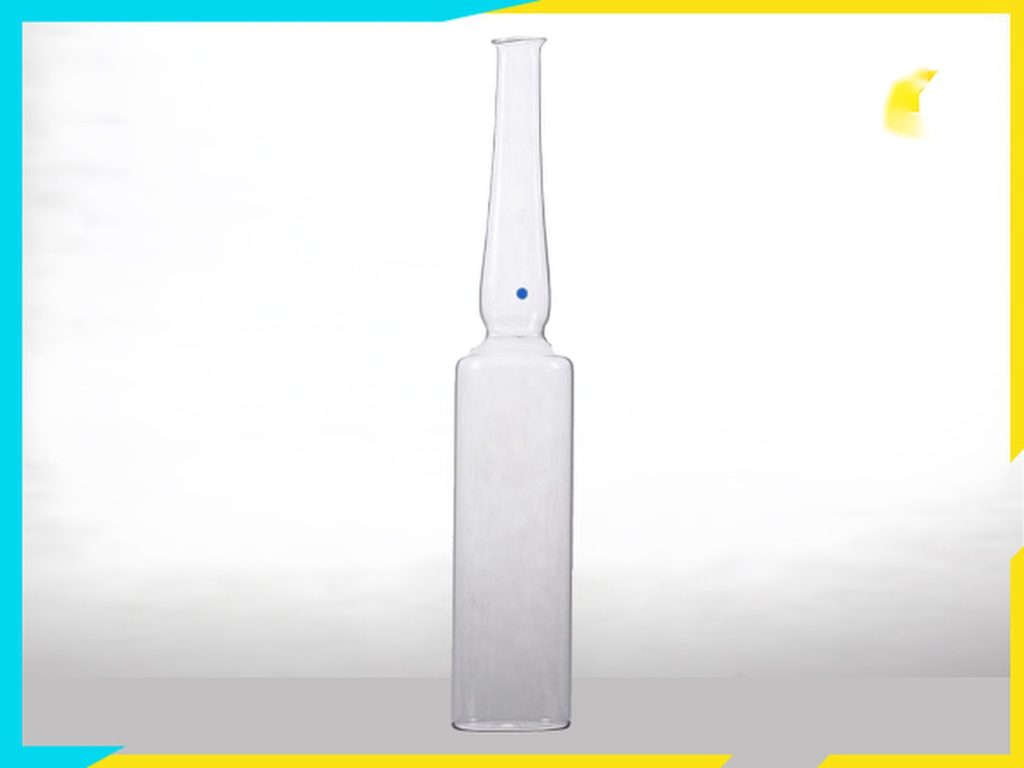
Low borosilicate Type II ampoules give buffered injectable solutions a sealed glass container at a lower cost than Type I borosilicate. The surface-treated glass raises hydrolytic resistance to Type II level, which is sufficient for formulations whose pH range limits alkali interaction.
Type II ampoules for injectables
Ampoules avoid the rubber stopper and aluminium cap entirely, so the only compatibility question is between the drug and the glass. For buffered solutions in a controlled pH range, Type II glass is often acceptable and reduces packaging cost. For unbuffered solutions, vaccines and biologics, Type I borosilicate ampoules should be used.
Specifications
| Capacity | Glass type | Opening | Typical use |
|---|---|---|---|
| 1 ml | Type II | Colour break ring | Small-dose buffered injectables |
| 2 ml | Type II | Colour break ring | Buffered injectables, vitamins |
| 5 ml | Type II | Colour break ring | Buffered solutions, electrolytes |
| 10 ml | Type II | Colour break ring / cut ring | Larger buffered doses |
| 20 ml | Type II | Colour break ring | Irrigation, buffered solutions |
Choosing between Type I and Type II
The choice should follow your stability data. If your formulation is buffered and stability studies show no glass interaction, Type II can be validated and reduces cost. If the product is unbuffered or sensitive, Type I is the safer route. We supply both so you can compare during development.
Quality documentation
Each lot is inspected for dimensions, cosmetic defects and hydrolytic resistance, with a certificate of analysis. Dimensional drawings are available for filling-line qualification.
Talk to our sales team about Type II ampoules for your formulation.
 EN
 FR
 AR
 DE
 ES
 PT
 FA
 RU