
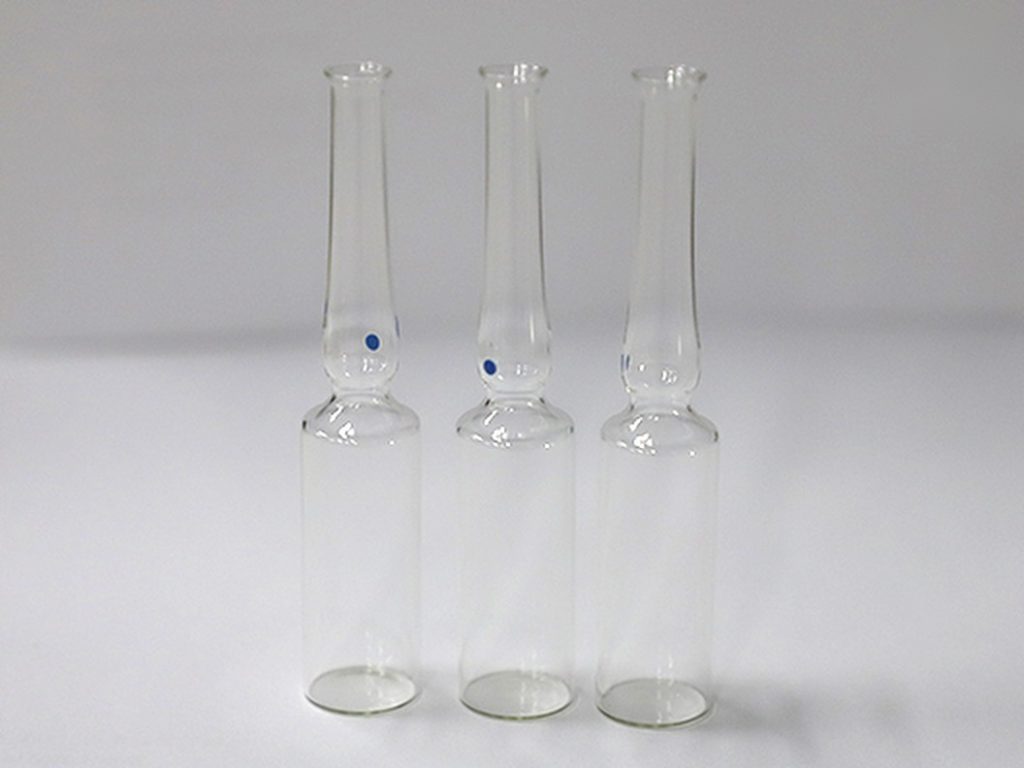
Glass ampoules look like a commodity: a small glass container, a coloured ring and a printed carton. In practice, two suppliers quoting the same 2 ml colour break ring ampoule can deliver very different opening behaviour, breakage rates and documentation. The difference is usually visible in the questions they can answer before the order, not in the price list.
This checklist covers what to verify when qualifying a glass ampoule manufacturer, how to compare quotations fairly, and which answers should make you look elsewhere.
1. Start with the glass, not the price
The first question is not “how much per thousand” but “which glass type, and where does the tubing come from”. Injectable ampoules are normally made from Type I borosilicate tubing tested to USP <660> and EP 3.2.1. Low borosilicate and soda-lime tubing exist for products where the regulatory filing allows them, but they should never appear in a quotation without being named.
Ask for the tubing certificate and confirm that the finished ampoules can be traced back to the tubing lot. A supplier who buys tubing on the open market without lot records cannot give you that traceability later. Our pharmaceutical glass tubing page explains the dimensional and hydrolytic resistance data that should accompany each lot.
2. Ask for the drawing, not just a catalogue
A catalogue gives nominal capacity and a photo. A drawing gives the dimensions that decide whether the ampoule works on your line: overall height, body diameter, neck diameter, constriction diameter, tip length and wall thickness, each with a tolerance. If a supplier cannot issue a drawing before the first order, the dimensions will be whatever the forming tools happen to produce.
Send your filling line details at the same time. The washing machine infeed and the sealing head determine the usable height and the packing pattern, and small differences matter when you convert from a cut ring to a colour break ring format.
3. Request break-force and defect data
Break behaviour is the quality characteristic users notice first. Ask for the break-force range the supplier works to, the test method and the sample size per lot. A supplier who only sends a cosmetic sample photo is not giving you the information you need to qualify the part.
Defect inspection matters as much as break force, but the useful question is not “do you have a camera” — it is which defect classes the camera rejects, what the rejection limit is and how it was validated. Our guides to ampoule breakability testing und ampoule defect inspection list the methods and defect classes to ask about.
4. Check documentation and change control
For a regulated product, the paperwork is part of the product. A qualified ampoule supplier should be able to provide:
- Certificate of analysis per lot, linked to the tubing lot.
- Hydrolytic resistance results to USP <660> or EP 3.2.1.
- Dimensional report against the agreed drawing.
- Break-force data and cosmetic inspection records.
- A written change-control process for tubing source, forming tools and printing ink.
The change-control point is often overlooked. A supplier that can silently switch tubing source is a supplier that can silently change the break behaviour of your next lot. Ask how you will be notified, and get it in writing.
5. Match the packing to your filling line
The same ampoule can arrive in shrink-wrapped trays, in nests and tubs, or in bulk cartons. Trays suit manual and semi-automatic lines; nests and tubs suit automated lines that need a fixed pattern. Packing is not a logistics detail — it is part of whether the ampoule can enter your washing machine without an adapter.
Also ask how transit breakage is handled: divided trays, protective layers, carton strength and pallet pattern all affect the real cost per usable ampoule.
6. Compare MOQ, lead time and trial orders
For a small pharmaceutical producer, the supplier’s minimum order quantity can matter more than the unit price. Ask separately for:
- MOQ per capacity and format.
- Sample quantity and sample lead time.
- Production lead time after drawing approval.
- Whether a mixed trial order across two or three sizes is possible.
A supplier that only quotes full-container volumes is not necessarily wrong for a large buyer, but it is a poor fit for a first order or a new product launch.
7. China, India or a local distributor?
Country is a weak proxy for quality. What actually differs is the tubing supply chain, export documentation experience, freight route and how much control the seller has over forming. The table below summarises the usual trade-offs; individual suppliers vary within every category.
| Überlegungen | Export-oriented factory in China | Indian manufacturer | Local distributor |
|---|---|---|---|
| Borosilicate tubing supply | Large domestic tubing base; Type I available in many diameters | Domestic and imported tubing, varies by supplier | Depends entirely on the source factory |
| Export documentation | Routine: COA, packing list, certificate of origin | Varies by supplier and destination | Limited visibility of the original lot records |
| MOQ flexibility | Often flexible for trial orders | Varies; domestic orders may be prioritised | Low MOQ, higher unit price |
| Freight and lead time | Sea freight to Europe or the US adds several weeks | Shorter to South Asia and the Middle East | Fastest, stock permitting |
| Control over forming | Direct | Direct | Indirect, through the supplier |
For most buyers the practical answer is to qualify the factory, not the country: request the drawing, the break-force data and the change-control commitment from every candidate, and compare the total landed cost rather than the unit price.
8. Ten questions to send before you request a quotation
- Which glass type do you use, and who supplies the tubing?
- Can you issue a dimensional drawing with tolerances?
- What break-force range do you guarantee, and how is it measured?
- Which defect classes do you reject, and at what limit?
- Is hydrolytic resistance tested on every lot?
- What does the certificate of analysis include?
- How do you notify customers of a tubing or tooling change?
- Which packing formats can you supply?
- What is the MOQ and the sample lead time?
- Who handles export documents and transit-damage claims?
9. Red flags in a quotation
- A price well below the market without an explanation of the glass type.
- No drawing, or dimensions described only as “standard”.
- Refusal to provide break-force data or a sample for testing.
- No lot traceability from finished ampoule back to tubing.
- Pressure to place a production order before sample approval.
- Vague answers on what happens if a lot fails inspection.
10. Compare quotes on total landed cost
Two quotations are only comparable when they include the same scope. Add the freight, duty, packing, expected breakage or rejection rate and the cost of carrying inventory to the unit price. A slightly higher unit price with better break behaviour and a packing format that runs on your line is often the cheaper option.
PharGlass supplies Type I borosilicate ampoules from 1 ml to 20 ml in colour break ring, cut ring and closed formats, with drawings, lot-linked COA and break-force data issued before the first production order. View the ampoule range, read the manufacturing process guide, oder send your drawing and annual volume for a quotation.
Häufig gestellte Fragen
Do I need Type I glass for every ampoule?
No. Type I borosilicate is the default for injectables, but low borosilicate and soda-lime ampoules can be acceptable for some oral, diagnostic or non-parenteral products. The choice depends on the formulation, the pH and the regulatory filing, and should be documented rather than assumed.
Can I get samples before placing an order?
Yes. A qualified supplier should provide samples from the proposed drawing and packing format so you can run them on your washing and sealing line before production. Ask whether the samples come from the same tooling that will be used for the order.
How do I verify colour break ring quality?
Check the ring position relative to the constriction, the break force, the opening behaviour and the number of loose glass particles after breaking. These should be measured on samples from each lot, not judged from a photograph.
What is the difference between AQL sampling and 100% inspection?
AQL sampling inspects a statistical sample from each lot and accepts or rejects the lot against a defined limit. 100% inspection, usually by camera, checks every ampoule but is limited to the defect classes the system was validated for. Most suppliers combine both.
Can a supplier change the tubing source without telling me?
It should not. A tubing change can alter forming behaviour and break force, so it should trigger notification and requalification under the supplier’s change-control procedure. Ask for that commitment in writing before the first order.
 DE
 EN
 FR
 AR
 ES
 PT
 FA
 RU